
Pest control in Marietta › Rodent & wildlife removal › Woodstock
This page covers rodent and wildlife work in Woodstock, the newest housing stock in the region and the one where the trees have only just caught up with the rooflines. For the whole method, start here, then read this for the local part.
What shapes the job here
How many openings there are and how high up, roof pitch and whether a ladder reaches the gable, whether a seal can be fastened to vinyl or has to go behind it, whether the eave run is shared with a neighbor, whether young are present, and whether the scope is trapping only or trapping plus exclusion.
1 The trees finally reached the roof
When Bradshaw Farms, Tomahawk and the rest of the 2001 to 2005 build band went in, the lots were cleared and replanted with young hardwood and a line of Bradford pears along the street. For fifteen years that landscaping was below the gutter line and the squirrel pressure in those subdivisions was genuinely low. It is not low now. Twenty-year-old trees in a front yard are at eave height, and a tree save strip left between two subdivisions is a corridor connecting both of them to the Noonday Creek and Little River greenway.
That is the real Woodstock change. The houses have not aged into the problem; the landscaping has grown into it. It also means the homeowner fix still works here better than almost anywhere, because the offending limbs are young, reachable and nobody’s heritage oak. Cutting branches back off the roof is the highest-value hour you can spend on this.
2 What fails on a 2005 roofline
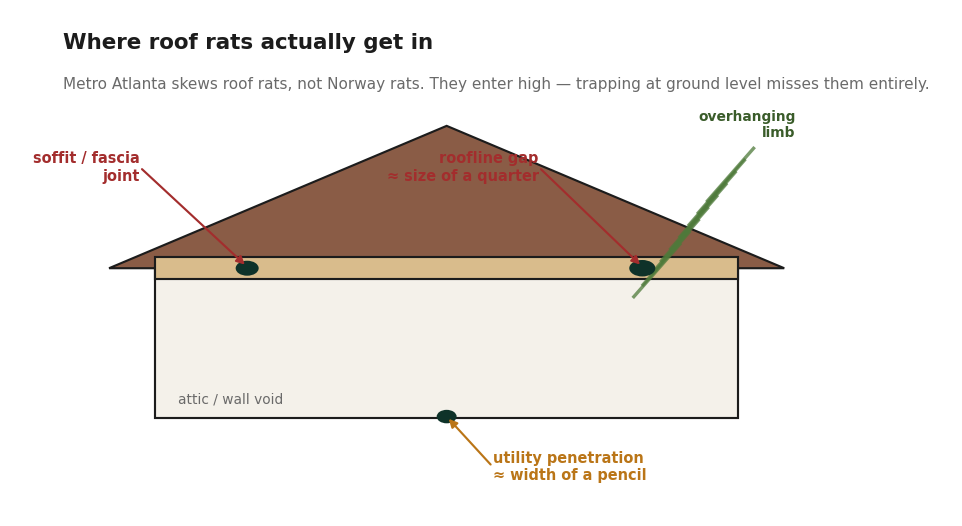
Look for four things. The gable louver, which on a production house of this era has a light screen stapled to the back and nothing else, and a gray squirrel pushes it through in a minute. The outside corner where a vinyl soffit panel has walked out of its J-channel, leaving a slot straight into the eave. The ends of a continuous ridge vent, where the baffle stops short of the cap. And the dryer or bath fan vent whose plastic flapper has broken off, which is a mouse door at a convenient height.
None of those is damage, which is why people walk past them for years. It also decides the repair. You cannot fasten anything meaningful to vinyl or aluminum, so either the panel comes off and goes back over galvanized hardware cloth, or the seal is made behind it into framing. Foam pushed into a soffit slot looks finished and lasts a season. Ask what the material is, what it is fastened to, and whether the vent is screened from behind rather than covered over. The same reasoning runs through pest control across Cobb County.
New house, open gable
Say the build year, the story count and where the noise is. On stock this age a licensed local crew usually knows which four places to check.
3 Townhomes share more than a wall
Woodstock has a higher share of attached housing than Cobb County as a whole, and a row of townhomes is one continuous eave with several owners. A single opening at the end unit gives access along the soffit run, and the animals then show up over a living room four doors down. Sealing your own unit and leaving the rest of the row open gets you a quiet month.
So on attached housing the inspection has to cover the whole run, and somebody has to talk to the association before the work is scheduled. That is a coordination problem rather than a technical one, and it is the reason an identical scope takes longer on a townhome than on a detached house two streets away. Get the association’s position in writing early; it is usually the thing that holds the job up.
Everything else is the same as the rest of the county. Trapping removes what is inside, sealing every opening in material the animals cannot chew is what ends it, and the order matters: seal all but the main run, get the animals out, close the last one when the attic is empty. Calls start the week overnight lows drop, usually mid-October, so the work belongs in late summer.
4 Nearby towns in this hub
North up the Etowah, and split between century-old frame houses and subdivisions newer than yours.
Similar build era, but with lake shoreline timber behind the lots and boats stored beside the house.
The opposite case: mature battlefield canopy and three build eras on the same street.
5 Questions
We never had squirrels here before. What changed?
The trees. Subdivision landscaping planted around 2002 is now at or above eave height, and the tree save strips between neighborhoods link up with the creek corridors. The house is the same; the route to it is new.
My neighbor in the row says it is not their problem. Is it?
On attached housing, usually yes. One continuous eave means one opening serves the whole run, and animals heard over your ceiling may be entering three units away. The inspection should cover the row and the association normally has to approve work on common elements.
Is a gable vent screen enough on its own?
Not the builder’s one. A light screen stapled behind a louver is the single most common Woodstock entry. The replacement is galvanized hardware cloth fitted from inside the attic and fastened to framing, which leaves the vent working and the opening closed.
When is the best time to have it done?
Late summer, before the middle of October. Calls begin the week overnight lows drop, and sealing an empty attic is a much shorter job than sealing one with animals and young already in it.
Start here
The complete Marietta pest control guide
What a correct job looks like on Piedmont red clay, how crawlspace and slab homes differ, and the questions that separate a real proposal from a guess.
Jaylan Jones — Cobb County Pest Solutions publishes independent guidance for North Georgia homeowners. We are a referral service, not a licensed pest control contractor, and we do not perform the work. How we work.

