
Pest control in Marietta › General pest control › Woodstock
This page covers what general pest work involves in Woodstock, the newest housing stock in this hub and the one most often assumed not to need any. Start with the Marietta pest control guide for the whole method, then read this for the local part.
What shapes the job here
Measured perimeter and property size, slab construction, how much of the wall is buried in bed material, irrigation and how wet it keeps the soil band, the species present, severity and the cadence you choose.
1 New is not the same as protected
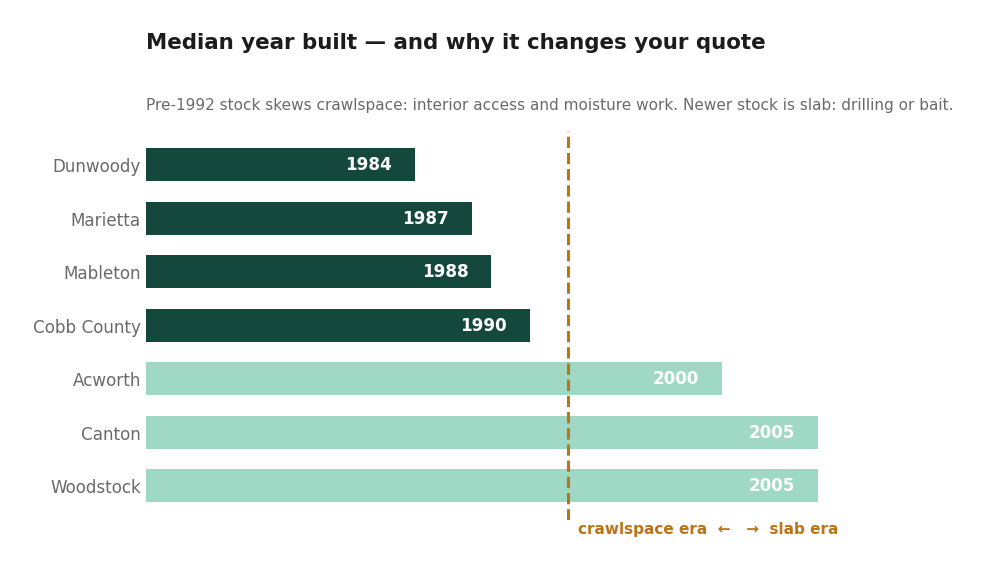
The most common assumption in Woodstock is that a 2005 house does not have the problems a 1965 house has. It does not have the same ones. A slab house has no vented crawlspace, no pier bases in damp soil and no original heart-pine framing to soften, and that genuinely removes a whole category of work.
What it adds is a continuous sheltered gap running right around the house, between the slab edge and the brick veneer. Odorous house ants use it as a ring road. They nest in the bed material and in the veneer void, then cross into the house at the sill, under door thresholds and at the places where pipes and cables pass through. You almost never see the nest, only the trail, which is why killing what is on the counter changes nothing. Crush one and it smells of rotten coconut; that smell is the identification.
Georgia also sits in Termite Infestation Probability Zone 1, the highest rating issued, and a slab house is not exempt from that either. Age changes the shape of the work, not whether it is needed.
2 The landscaping is the problem
Subdivision landscaping in Woodstock follows a pattern: a bed running the full width of the front, shrubs planted close to the wall, pine straw or mulch refreshed every spring, and an irrigation zone that waters all of it. Twenty years of annual top-ups later, the bed material sits above the brick ledge on a lot of houses, which hides the one line a technician most needs to see and puts constantly damp organic matter in direct contact with the wall.
Irrigation makes it permanent. A zone running three mornings a week keeps the soil band against the footing damp through the whole dry part of summer, which is exactly when that band would otherwise bake out and become inhospitable. North Georgia already has no dormant season, only a slower one; an irrigation controller removes even the slow part.
Three changes do more than any product: pull bed material back below the brick ledge, turn the heads so they water plants rather than the wall, and keep a hand’s width of bare soil along the foundation so a treated band actually lands on soil. That argument, in full, is in the complete guide.
Newer house, same ant trail
Mention the slab, the beds and the irrigation schedule. A licensed local crew will know which of the three is feeding the trail.
3 Where the water collects around Towne Lake
Woodstock was built out on land that was cleared and graded, which means the drainage on your lot is an engineered thing rather than a natural one. Towne Lake and the Noonday Creek corridor sit at the bottom of that engineering, and the swales and detention basins that feed them run between houses. Those swales were cut in compacted red clay, which slumps and settles, so a lot that drained correctly in 2005 may not drain correctly now.
That is why a correct job here still starts outside with a slow lap of the foundation, reading grade and drainage before anything is applied. Where does the ground slope back toward the house. Where does a downspout discharge into a bed instead of past it. Where does the patio sit level with the slab so water stands against the wall. On a slab house those questions replace the crawlspace inspection; they do not disappear with it.
German cockroaches are the indoor exception in Woodstock as everywhere else. They live in the warm wet walls behind kitchen and bathroom plumbing and need gel bait placed in the harborage itself, with a vacuum and a follow-up. An exterior band never reaches them, and a repellent baseboard spray scatters them into adjoining voids.
4 Nearby towns in this hub
The same new subdivisions, plus an old mill town on piers beside the Etowah.
Lake lots at Allatoona, where stored boats and dock gear do what landscaping does here.
The opposite case: a median of 1978, vented crawlspaces and Square-era houses on piers.
5 Questions
Is pine straw worse than mulch against the house?
Both hold moisture against the wall and both get topped up rather than replaced, which is how the level creeps above the brick ledge. Pine straw mats down and sheds water sideways, hardwood mulch holds it in place longer. The depth and the level matter far more than the material: keep either one low, and keep a strip of bare soil along the foundation.
My HOA maintains the front beds. What can I do?
Ask the association’s contractor not to top up against the wall, and do the strip along the foundation yourself if they will not. It is a small amount of work and it is the single change that most improves what a service visit achieves on a slab house.
Should I run irrigation less in summer?
Running it away from the wall matters more than running it less. Turn or cap the heads that throw water onto the brick and the bed right at the foundation, and let the rest of the lawn have what it needs. A dry band at the wall is worth having; a dry lawn is not the goal.
How often does a slab house need service?
Quarterly on the exterior, the same regional cadence as everywhere else in north Georgia. There is no genuinely dormant season, and a treated band breaks down under rain, irrigation and sun in a matter of months. On an irrigated Woodstock lot the band is wetted more often than most, so the interval is doing real work.
Start here
The complete Marietta pest control guide
What a correct job looks like on Piedmont red clay, how crawlspace and slab homes differ, and the questions that separate a real proposal from a guess.
Jaylan Jones — Cobb County Pest Solutions publishes independent guidance for North Georgia homeowners. We are a referral service, not a licensed pest control contractor, and we do not perform the work. How we work.

