
Pest control in Marietta › Mosquito control › Powder Springs
This page covers what mosquito work involves in Powder Springs, a town of early-1990s subdivisions laid out around detention basins, and what that engineered water does and does not do. Start with the Marietta pest control guide for the whole method, then read this for the local part.
What shapes the job here
Whether a basin sits within a short flight of your lot and whether it actually drains, how the original grading left your back corner, how dense the thirty-year-old foundation planting has become, lot size and how much is reachable, the number of containers on your lot and the ones either side, and the interval you keep from April to October.
1 What the detention pond really does
Powder Springs built out through the early 1990s, and the subdivisions of that era came with a stormwater detention basin tucked into the low corner of each neighborhood. Everyone blames it. The honest picture is more specific than that. A basin that works as designed fills in a storm and empties within a day or two, which is nowhere near the week a container breeder needs. A basin that has held permanent water long enough to grow a real edge has fish and predators in it, which also makes it poor ground.
What does produce mosquitoes is a basin that has stopped working properly. Thirty years of silt and leaf litter leave shallow depressions that hold water for weeks after the rest has drained. The outfall structure and its trash rack collect bottles, buckets, polystyrene boxes and the odd tire, each a container sitting in shade with nothing to disturb it. The riser and low-flow channel silt up and puddle. Those are the places worth pointing at, and they are all repairs rather than treatments.
The basin is almost always held by the association or a drainage easement rather than by you, so neither you nor a contractor working for you can touch it. That makes it an association conversation: get the basin inspected, the outfall cleared of trash and the low-flow channel re-cut so it drains. That one piece of maintenance does more for a whole street than any number of private visits, and it covers every household at once instead of each one arranging its own.
2 Thirty years of grading and planting
The median Powder Springs house went up around 1992, which means two things have had three decades to happen. The first is grading. Early-1990s subdivisions were cut into the hillsides with short setbacks and a lot of fall directed to the back of the lot, and on Piedmont clay that back corner never properly dries between storms. A rut, a settled trench over a utility run, a hollow where a tree was taken out: on this soil those hold water long enough to breed, and they are fixable with a wheelbarrow of soil rather than a treatment.
The second is the planting. Shrubs put in as one-gallon stock in 1992 are now a dense shaded mass against the wall, and the trees planted with them have closed over the roof. That is prime daytime resting habitat, and it is where a residual actually has to land, on the undersides of the lower foliage rather than across the lawn. Watch where the wand is pointed. A technician walking the lawn with the spray up in the air is wasting your afternoon.
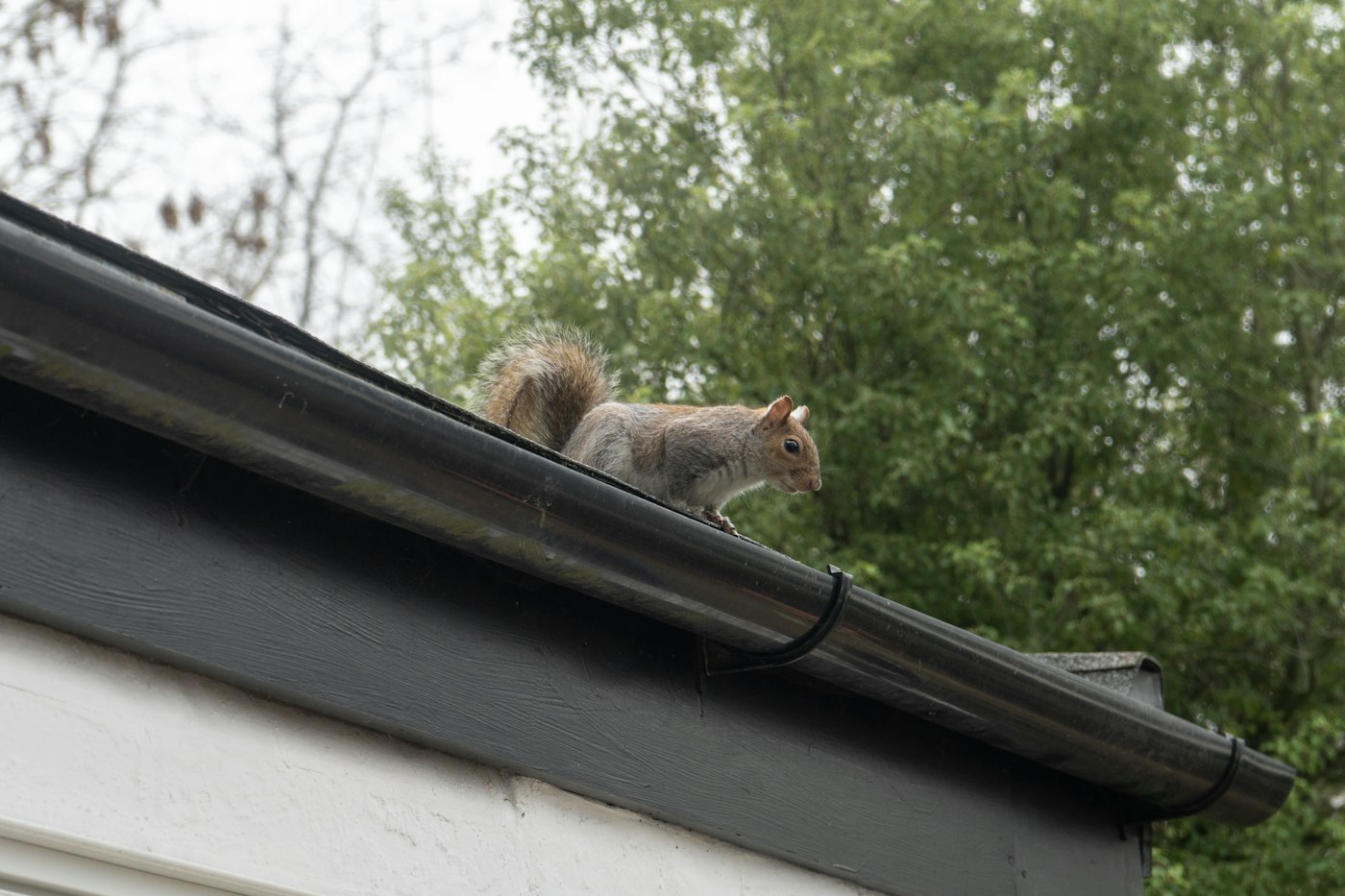
Those same mature trees keep the gutters loaded. A blocked gutter run on a 1990s roofline holds a shallow trough of standing water right through the summer, out of reach of anything applied at ground level, and it is one of the most productive containers a Powder Springs house has. Clear them in late spring and again in midsummer. The full method is in the complete guide.
Say where the basin sits
Backing onto the pond and sitting four streets away are different jobs. A licensed local crew should walk the back of your lot before anything is applied.
3 Short flights and close neighbors
The Asian tiger mosquito is a weak flier that spends its life close to where it emerged, and that fact cuts both ways in a Powder Springs subdivision. If the basin is four streets over, it is probably not your problem, and somebody has sold you a story. If it is at the end of your cul-de-sac, or if the neighbor two doors down has a stack of pots and a paddling pool sitting out since June, that is your problem whether you like it or not.
So the first diagnostic is geography rather than product. Where is the biting worst, what time of day, and what sits within a short walk of that spot. On these lot sizes the answer is usually visible from your own garden. Powder Springs Creek and Lucille Creek matter the same way: they contribute shade and damp ground rather than larvae, so the lots along them need the longer schedule and the tighter boundary work.
The containers to deal with on your own ground are the ordinary ones. Pot saucers, the bird bath, a wheelbarrow upright against the fence, the bin with no lid, a tarp over the woodpile, the dish under an outside tap, the corrugated downspout extension with a sag in it. Each holds water about a week, which is all this species needs, and none of them takes product to fix.
4 Nearby towns in this hub
Downstream and lower: Sweetwater Creek and Noses Creek, where the standing water is natural rather than engineered.
Down the Silver Comet: mid-1980s crawlspace stock, where the wettest ground is under the floor.
North east of here: older stock, grown-in plantings and the Sope Creek corridor rather than basins.
5 Questions
Is the detention pond behind my house the cause?
Only partly, and often less than you think. A basin that drains within a day or two after rain is not breeding this species, and one with permanent water usually holds predators. What breeds is the silted shallow end that no longer drains and the rubbish caught at the outfall. Ask the association to have the basin cleared and the low-flow channel re-cut rather than assuming the whole pond is the problem.
Can a company treat the pond for me?
Not without permission from whoever holds it, which in most Powder Springs subdivisions is the association or an easement holder. Nobody can treat water on land you do not control. If it genuinely needs attention, the association authorising the work covers every household at once.
What should I fix in my own yard first?
Gutters, then the back corner. Thirty-year-old trees over a 1990s roofline keep the gutters holding water all summer, and 1990s grading left most of these lots with a low spot at the back that never dries. After that it is the ordinary containers: saucers, bird bath, wheelbarrow, lidless bin, tarp, downspout extension.
How often does the barrier need renewing?
Every three to four weeks through the April to October season, and sooner after a wet week. Ask before signing what happens if you need an extra visit after heavy rain, because some agreements include it and some treat it as a separate callout.
Start here
The complete Marietta pest control guide
What a correct job looks like on Piedmont red clay, how crawlspace and slab homes differ, and the questions that separate a real proposal from a guess.
Jaylan Jones — Cobb County Pest Solutions publishes independent guidance for North Georgia homeowners. We are a referral service, not a licensed pest control contractor, and we do not perform the work. How we work.

