
Pest control in Marietta › Termite control › Liquid barrier or bait system
There are two ways to protect a Georgia house from subterranean termites, and they work on completely different principles. This page explains what each one physically involves, what a technician is doing while the truck is in your driveway, and what actually decides which method you are offered. Start with the complete guide for the whole method, then read this for the treatment itself.
Why Georgia is its own case
Georgia sits in Termite Infestation Probability Zone 1, the highest tier on the national map. Piedmont red clay holds moisture far longer than the sand south of the fall line, so eastern subterranean termites here forage year round instead of shutting down. Swarmers appear March to May, but the colony that sent them has been working all winter.
1 What installing a liquid barrier actually involves
A liquid treatment is a soil job, not a spray job. The crew digs a narrow trench against the foundation wall, roughly six inches wide and six inches deep, all the way around the structure. Diluted termiticide goes in at a labeled rate per linear foot, and the soil that came out is replaced as it is treated, so the backfill is treated too. Done properly it is slow, muddy work.
Where the trench cannot go deep enough, the technician rods: a long hollow probe is pushed into the soil at intervals and product is injected below the surface. Rodding is how you treat under an established flower bed, alongside a walkway, or down to the footing on deep foundation walls.
Then there is concrete. A slab home, a porch, a stoop, a patio poured against the house, an attached garage: anywhere soil is sealed under concrete, the only way to reach it is to drill. Holes go in at regular spacing through the slab or the masonry void, product is injected underneath, and the holes are plugged and patched. Expansion joints and the seam where a porch meets the wall get the same attention, because that seam is a common entry route. If a proposal says nothing about drilling and your house has a slab porch, ask how the soil under it gets treated.

2 What a continuous treated zone means
The phrase on the label is a continuous treated zone, and the word doing the work is continuous. Termites do not search the perimeter politely. A colony sends workers out in every direction, and they find whatever opening exists. A band that covers ninety percent of the foundation is not ninety percent effective; it is a wall with a door in it.
That is why obstructions get discussed before the work starts. A deck built tight to the wall, an air conditioning pad, a brick walkway, an addition poured against the original slab: each one is a place where the band either continues or stops. Interior piers and interior foundation walls in a crawlspace need treating too, not just the outside line.
Soil disturbance afterward matters for the same reason. Dig a bed, trench a sprinkler line or regrade a corner and you have removed part of the band. Tell whoever holds the warranty and have that stretch retreated.
Ask which method your house actually needs
Foundation type, perimeter obstructions and crawlspace access decide this long before anyone opens a product catalog.
3 Repellent and non-repellent chemistry
Not all liquid products behave the same way, and the difference is worth understanding because it changes what the barrier does. Older repellent termiticides, mostly pyrethroids, are detectable to termites. Workers hit the treated soil, recognize it and go around. That protects the house as long as the band is unbroken, but it also means a single gap becomes the route everyone takes, and the colony survives next door at full strength.
Non-repellent products are undetectable. A worker walks through treated soil, picks up a dose and passes it to nestmates through grooming and feeding. The effect spreads beyond the individual that crossed the line, which is why non-repellent chemistry is the standard choice against an active infestation.
Ask which product is being applied and read the label name on the paperwork. You are entitled to know what went into the soil, at what dilution and in what volume. What a real proposal contains is laid out in the Marietta pest control guide.
4 How a bait system works
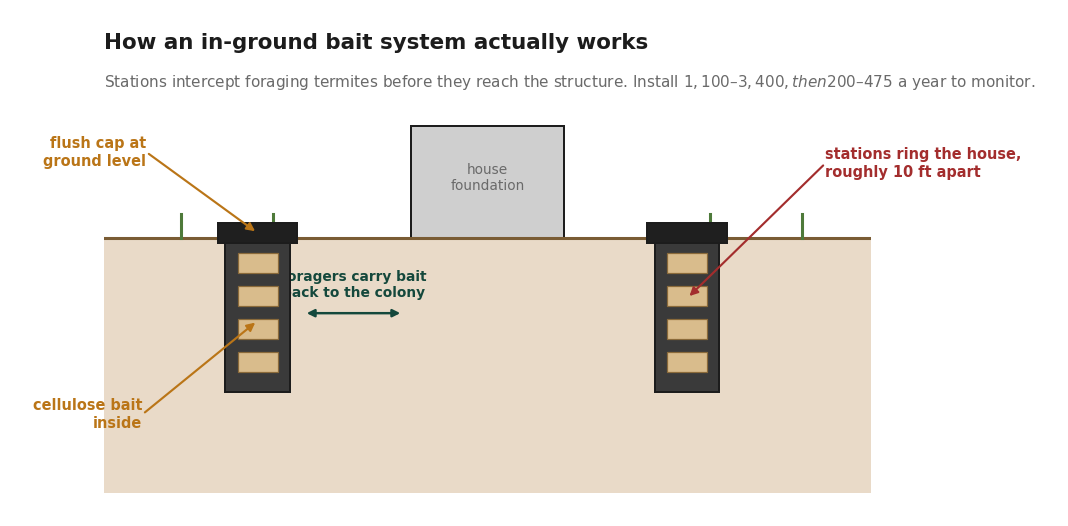
A bait system does not try to block anything. Plastic stations are installed in the ground around the house at regular spacing, usually every ten to twenty feet and closer where activity or moisture suggests it. Each station holds a cellulose matrix treated with an insect growth regulator. Foraging workers find the station the way they find any other wood source, feed, and carry the material back to the colony.
The active ingredient interferes with molting. Termites shed their exoskeleton to grow, and a colony that cannot molt stops replacing its workers. The collapse is gradual, over months rather than days, but it reaches the whole colony. The trade is speed: if swarmers are coming out of a baseboard in April, patience is not what you want on its own.
Stations are checked on a schedule, and the inspection record is the product. A system nobody services is a row of plastic lids in the yard.
5 What decides which one you are offered
Three things, in roughly this order. First, the property. If the perimeter is so broken up by porches, patios, planters and hardscape that a continuous trench is impractical, bait starts to look sensible. A well, a cistern or a drainage structure close to the wall constrains where liquid can go. A clean, open slab perimeter on a 1990s subdivision lot is the easiest liquid job there is.
Second, the situation. Active infestation with visible tubes and damaged framing usually calls for a non-repellent liquid, sometimes with bait around it. A house with no current activity in a high-pressure zone is a monitoring problem, which is what bait is built for. Plenty of Georgia companies install both, which is a legitimate approach as long as somebody tells you it is a choice.
Third, and more often than anyone admits, the company. Bait systems are proprietary, so a firm licensed for one brand presents that brand, and a firm set up for trenching and drilling presents liquid. Neither is dishonest, but the recommendation is partly about who is standing in your driveway. A second opinion on the method, not just on the paperwork, is the fix. To find another licensed company, start here.
Keep reading in this topic
Linear feet of foundation is the unit of work for everything on this page. Here is why the measurement comes first.
Nobody should propose a method before somebody has been under the house with a light and a moisture meter.
Whatever is installed, the bond attached to it decides what happens if termites come back.
6 Questions
How long does a liquid barrier keep working in Georgia clay?
Manufacturers talk about several years to a decade for a correctly applied non-repellent product, and Piedmont red clay binds termiticide reasonably well. The band degrades unevenly, though: fastest where water moves and where soil has been disturbed. That is what the annual re-inspection is for.
Do I have to let them drill my porch?
You can refuse, but understand what you are refusing. Soil under a slab porch cannot be reached any other way, and a porch poured against the house is a common entry route in Georgia. An area left untreated should be written on the paperwork as excluded, which usually excludes it from the warranty as well.
Will a bait system stop termites that are already in my wall?
Not quickly. Bait works on colony growth over months, which is the right tool for prevention but a slow answer to active damage. Most companies treat an active infestation with a non-repellent liquid, then use bait for monitoring. Ask which part of the plan addresses the termites in the structure today.
What should the paperwork list when the job is finished?
The product name and dilution, the volume applied, the measured linear footage treated, where holes were drilled, any area left untreated and why, and the warranty terms. A future buyer, an inspector or a second company will read that document. Keep it with the deed.
Start here
The complete Marietta pest control guide
What a correct job looks like on Piedmont red clay, how crawlspace and slab homes differ, and the questions that separate a real proposal from a guess.
Jaylan Jones — Cobb County Pest Solutions publishes independent guidance for North Georgia homeowners. We are a referral service, not a licensed pest control contractor, and we do not perform the work. How we work.

