
Pest control in Marietta › Guides › What decides a quote
Two houses on the same street can be quoted very differently for what looks like identical work. That is not a trick. A quote is assembled out of things a technician measures and sees on the day: how far it is around your foundation, what that foundation is, how much of it he can physically reach, what is living there and how long it has been there. This page walks through each of those inputs so you can read a proposal instead of guessing at it. Start with the complete guide for the method behind the work itself.
The short version
There are no numbers on this page. The variables below are what a number is made of, and they are the only part of a proposal you can check for yourself before you sign it.
1 What the company is actually looking at
A real assessment starts outside and takes a while. The technician walks the foundation slowly and reads the building: which way the ground slopes, where a downspout discharges against the wall, where mulch has been piled above the brick ledge, which vents are blocked, where siding meets soil, where a deck ledger has no flashing. None of that is theater. Each one is either labor he will have to add or a condition that will defeat the work if nobody mentions it.
The setting matters because Georgia is not an average market. The state sits in Termite Infestation Probability Zone 1, the highest tier in the country, and metro Atlanta sits on Piedmont red clay that holds moisture far longer than the sandy soils south of the fall line. That extended moisture window is why eastern subterranean termites forage here year round and why general pest pressure never really stops. A company working this soil is scoping a longer season than a company in Ohio, and the scope is part of what you are being quoted for.
If somebody walks to the door, looks at the kitchen and writes a number in four minutes, they have measured nothing. The number may still be fine. You just have no way of knowing, and neither do they.

2 Size, perimeter and what gets measured
For exterior work, the number that matters is not the square footage on your tax record. It is the measured distance around the outside of the structure. A rambling 1970s ranch and a compact two-story can have the same floor area and wildly different perimeters, because the ranch spreads its walls across the lot while the two-story stacks them. Treating or inspecting a foundation is a task measured in feet of wall, so the sprawling house is simply more work.
Several things lengthen that measurement without changing the house much on paper: an attached garage, a bump-out or bay window, a brick stoop, a sunroom added in the 1990s, an addition off the back that doubled the number of inside corners. Detached structures are separate again. A workshop, a pool house or a barn is its own perimeter and should appear on the proposal as its own line, not get absorbed silently into the main house.
Interior square footage still counts, but for different reasons. It drives how long an inside inspection takes, how many rooms get monitored, how many bait placements a kitchen and bath job needs. Ask any company for the footage they measured and where they measured it. A company that can tell you is a company that went around the house.
3 Foundation type, access and build era
Foundation type changes the job more than almost anything else. A crawlspace house has an under-floor void somebody has to enter with a light: subfloor, piers, sills, ductwork, insulation, moisture readings, soil-to-wood contact. A slab house has no void and no access, so the work happens at the slab edge, the thresholds and the utility penetrations, and reaching soil beneath a patio or a garage floor means drilling through concrete. Neither one is the easy option. They fail in different ways and they take different labor.
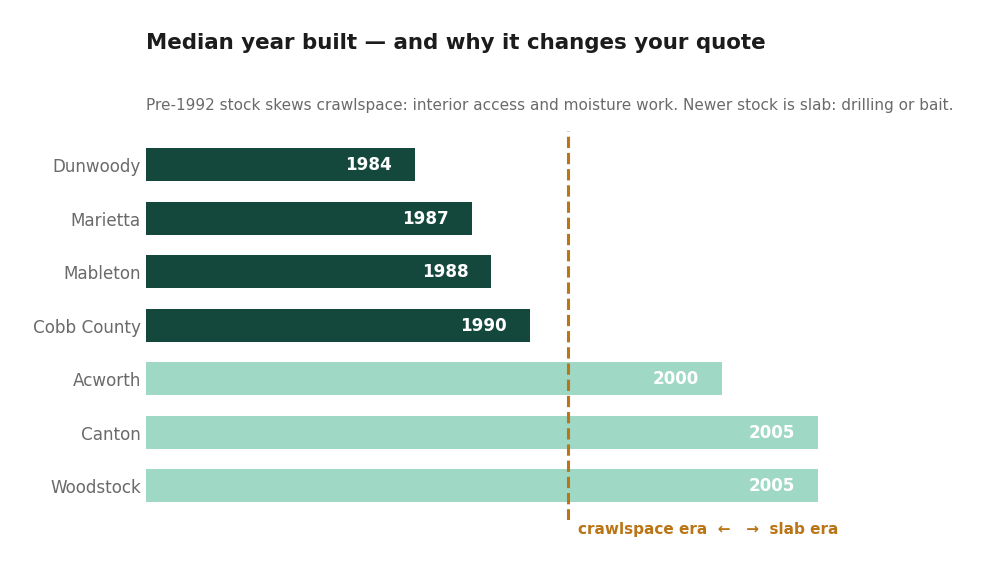
Build era tells you which one to expect before anyone arrives. Marietta’s median build year is 1978 and Dunwoody’s is 1984, so those are largely crawlspace towns; Woodstock’s median is 2005 and the subdivisions there are slab-on-grade almost without exception. Kennesaw, Acworth and Canton are genuinely mixed, sometimes within a single street, which is why a neighbor’s proposal is a poor guide to your own. The era also predicts the condition of the details that matter: sill height above grade, vent size, whether the crawl has a vapor barrier, whether fifty years of added mulch has buried the brick ledge.
Then there is access, which is the quietest line item on any proposal. Eighteen inches of crawl clearance instead of thirty. A crawl entrance behind a deck. Stored boxes filling the void. A foundation wall buried behind a thirty-year-old holly hedge. A steep lot where the back of the house is a story off the ground. A locked gate, a dog, a tenant who is never home. Every one of those converts a straightforward hour into an awkward three, and a company that has seen your access is quoting something real. The method behind all of this is laid out in the Marietta pest control guide.
Make them measure your house
Perimeter, foundation, access and species. A licensed local crew should put all four in writing before you decide anything.
4 Species, severity and the season
Species decides method, and method decides effort. Odorous house ants are worked from the outside with bait and a perimeter strategy; crush one and it smells of rotten coconut, which is how you confirm them in thirty seconds. Carpenter ants are a different job entirely, because they excavate damp wood and the colony is a symptom of water you have not found yet. German cockroaches live in the wet walls behind kitchen and bath plumbing and need gel bait placed in the harborage itself, so nothing applied around the outside of the house touches them. Each of those is a different visit length and a different follow-up schedule.
Severity is the second half of it. A few scouts along a kitchen counter in June is a different proposition from a population that has been breeding behind a dishwasher for a year, and a termite colony that produced swarmers in your window track has usually been feeding for two or three years before you saw it. Severity changes the number of visits, the amount of product, and whether the work includes repairs to the conditions that caused it.
Season is the input nobody mentions. Termite swarms run March through May, so inspection calendars in April are weeks deep. Mosquito work runs April through October. Rodents start moving indoors from mid-October, which is also when leaf litter banks against foundations and gives everything else a place to hide. Calling in the quiet part of the year buys you a technician who is not working a queue, and that alone changes how long he spends at your house.
5 One visit, or an ongoing program
A one-off visit is a transaction: somebody comes, treats what is in front of him, and leaves. It suits a discrete and identified problem, like a wasp nest in a soffit or a single outdoor fire ant mound. What it does not include is any obligation to come back. If the population rebounds in five weeks, that is a new visit and a new conversation.
An ongoing program is a different thing. You are buying a schedule, a record of what was found each time, and, on a decent plan, retreatment between scheduled visits at no extra charge when something comes back. In a state with no dormant season that re-service clause is most of the value, and it is the clause people forget to read. Ask what the cadence is, what happens between visits, what the renewal terms are, how much notice cancellation takes, and whether the rate is locked for the term. Monthly and quarterly cadences suit different houses, and that comparison has its own page.
Termite work sits apart from all of it. It is scoped separately, warranted separately, and the warranty tier is the part that matters: a retreatment-only agreement obliges the company to come back and treat again, while a repair agreement obliges it to fix damage up to a stated limit. Those are very different promises and they are not interchangeable. Read the tier before you read anything else, and if you want a human to walk it with you, talk to a licensed local pro.
Read next
What each cadence actually covers, when monthly is genuinely warranted, and the plan terms worth reading twice.
Odorous house ants, carpenter ants and fire ants, and why interior spraying alone never ends an ant problem.
Exterminator or pest control company, Georgia licensing, and integrated pest management versus spray-and-go.
6 Questions
Why is my neighbor’s quote so different from mine?
Usually perimeter and foundation. Two houses on one street can differ by a third in measured foundation length, and one may be crawlspace while the other is slab. Add access — a buried crawl entrance, a hedge against the wall, a steep back lot — and the same scope of work is a different amount of labor. Ask both companies for the footage they measured.
What should appear in writing before I sign anything?
The measured perimeter, the foundation type, the target species, the products and where they go, the visit schedule, what happens if something comes back between visits, the warranty tier, the renewal terms and the notice required to cancel. A proposal that names none of those is not a proposal.
How do I tell whether my house is crawlspace or slab?
Look low on the brick for small rectangular vents, usually every eight to ten feet. Vents mean a crawlspace. A continuous brick skirt with no vents, and a floor level close to the outside grade, usually means slab. In Kennesaw, Acworth and Canton both types sit on the same streets, so it is worth checking rather than assuming.
Does the time of year change anything?
It changes availability and attention. Termite swarms run March to May and inspection calendars fill; mosquito season runs April to October; rodent calls spike from mid-October. Booking in the quiet months means a technician who is not working through a queue, which usually means a longer and more careful first visit.
Is one visit ever enough?
For something discrete and visible — a wasp nest, a single fire ant mound away from the house — often yes. For anything that breeds indoors, or anything subterranean, no. German cockroaches need follow-up placements to reach the generation that was still in the egg case on the first visit, and termite work is never a single-visit subject in a Zone 1 state.
Start here
The complete Marietta pest control guide
What a correct job looks like on Piedmont red clay, how crawlspace and slab homes differ, and the questions that separate a real proposal from a guess.
Jaylan Jones — Cobb County Pest Solutions publishes independent guidance for North Georgia homeowners. We are a referral service, not a licensed pest control contractor, and we do not perform the work. How we work.

