
Pest control in Marietta › Guides › Ant control in Georgia
Ants are the most common call in north Georgia and the most commonly mistreated. Almost every failed ant job comes from the same two mistakes: nobody worked out which species it was, and the treatment went where the ants were walking instead of where they were living. This page covers identification, what each species actually requires, and why the can under your sink keeps letting you down. Start with the complete guide for the wider method.
The test anyone can do
Crush one on a paper towel and smell it. Rotten coconut means odorous house ant. No smell, and a big ant over a quarter inch with a smooth, evenly rounded back, usually means carpenter ant — and a damp timber somewhere nearby.
1 Identify before anybody treats anything
Four kinds of ant account for most of what happens in a Cobb County house. The odorous house ant is small, dark brown, and moves in a ragged line rather than a neat one. Crush it and you get a sharp smell people describe as rotten coconut or blue cheese. It nests outdoors in mulch, leaf litter, under landscape timbers and pine straw, and it moves nests readily, which is why chasing it with a spray scatters the problem instead of ending it.
Pavement ants are similar in size and nest under slabs, driveways, patios and front walks. They are the ants you see coming out of a crack in the concrete apron. Argentine ants form enormous connected colonies and run obvious highways along a foundation edge. Both are nuisance species and both respond to the same outside-first approach.
Carpenter ants are the outlier. They are large, often half an inch, usually black or black and red, with a single node at the waist and a smoothly curved back. Seeing one indoors in February is meaningful, because it means a nest is inside the heated envelope rather than out in the yard. Fire ants you will identify by the mound and by the sting, not by looking closely. Each of those four is a different job with different equipment, and a technician who has not named the species has not started work.
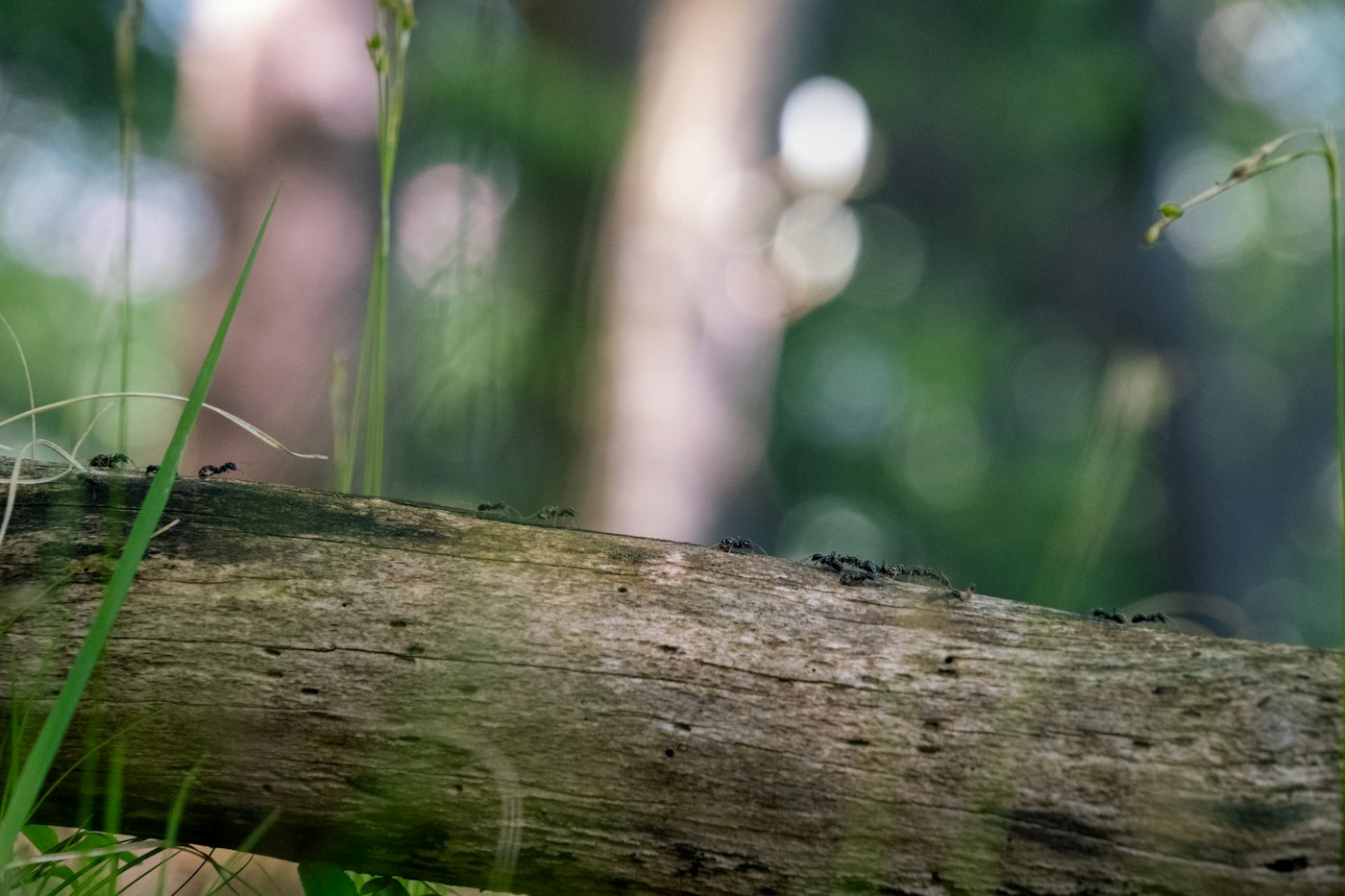
2 Carpenter ants are a moisture problem in disguise
Carpenter ants do not eat wood. They excavate it to make galleries, and they overwhelmingly excavate wood that is already soft with water. That makes them a symptom with a cause attached. Find the ants and you have found a leak, a drip, a flashing failure or a ventilation problem, and it has probably been running longer than you think.
The usual addresses on a north Georgia house are consistent: a porch post standing under an overflowing gutter, a deck ledger with no flashing behind it, a window sill on a shaded north wall, fascia under a valley that dumps water, the sill plate above a crawlspace with no vapor barrier, and the framing around a shower or a tub where a seal failed years ago. Mature hardwood canopy makes it worse by keeping those surfaces from ever drying, which is why the shaded side of a house produces most of the finds.
The evidence is often more useful than the ants. Look for frass, a small pile of coarse sawdust mixed with insect parts, under a ceiling corner or at the base of a post, and listen for a faint rustling in a wall on a quiet evening. Treatment means finding and treating the nest void, usually by dust or foam, and then fixing the water. Skip the second half and a new colony takes the same address within a season or two. The wider logic of reading a house this way is in the Marietta pest control guide.
Name the ant before you treat it
A licensed local crew should identify the species, find the nest, and tell you what water problem is feeding it.
3 Fire ants are a yard job, not a perimeter job
Imported fire ants are established across Georgia and they behave nothing like the ants that come indoors. They stay outside, they build mounds in open sunny turf, and after heavy rain the mounds appear overnight in places that looked clean the day before. On red clay the mounds hold their shape well and can get large; disturb one and the response is immediate and coordinated, which is the part that matters if you have small children, a dog, or anyone in the house who reacts badly to stings.
Because the problem is spread across turf rather than concentrated at a wall, the work is a broadcast yard application with spreading equipment, not the perimeter band a general visit applies. That is why it is scoped as its own job on almost every proposal. Treating individual mounds has its place for an urgent one next to a play set, but mound-by-mound work alone tends to relocate colonies rather than reduce them.
Two practical points. Bait works best when the ants are actively foraging, which in this climate means mild ground temperatures in spring and early autumn rather than the middle of a July afternoon. And mounds along a driveway edge or against a slab are worth dealing with promptly, because fire ants will exploit a gap in a concrete apron and occasionally follow irrigation lines toward a structure.
4 Bait versus spray, and why interior-only fails
A bait works because ants carry it home. Foragers take it back and share it through the colony, so the queen and the brood receive the dose and the colony collapses from the middle. A contact spray works the opposite way: it kills on contact, which means it only ever reaches the small fraction of the colony that happens to be out walking. Most of an ant colony is never visible to you.
That is the whole reason interior-only treatment fails. The ants in your kitchen in June are scouts from a nest in the mulch bed, under the front step, or in a landscape timber eight feet from the wall. Kill the scouts and the nest sends more. Worse, some spray products are repellent: hit a trail with one and a colony that was using a single reliable route can bud into several smaller nests spread around the foundation, turning one problem into four. If you have been spraying for a month and it is getting broader rather than smaller, that is probably what happened.
The sequence that works is outside-in. Find the nest or at least the trail’s entry point, place bait where the ants are already foraging, leave it alone while they work it, and resist the urge to spray over the top of it, which contaminates the bait and ends the whole effort. Then remove what made the trail worthwhile: trim limbs and shrubs off the siding, pull mulch back below the brick ledge, move the firewood pile away from the wall, fix the downspout that soaks one corner, and keep dry goods in sealed containers so an exploring scout finds nothing to report. Those steps are also the foundation of any sensible program across Cobb County.

Read next
Why species and severity change the scope of an ant job as much as the size of the house does.
German cockroaches work the same way as ants in reverse: gel bait in the harborage, never a perimeter spray.
Integrated pest management versus spray-and-go, and what a Georgia license actually certifies.
5 Questions
Why do ants appear after heavy rain, and again in a dry spell?
For opposite reasons. Heavy rain floods outdoor nests in mulch and leaf litter and pushes colonies to higher, drier ground, which is often your wall void. A long dry stretch sends them looking for water instead, and they follow condensation on plumbing lines into kitchens and bathrooms. A wet June and a dry August both produce ants indoors.
Should I clean up the trail before a technician arrives?
Wipe up spills, but leave the trail itself alone if you can stand it. A live trail is the most useful thing in the house: it shows where the ants enter and which direction they return to, which is how the nest gets found. Spraying it before the visit hides the evidence and can scatter the colony.
Are carpenter ants as serious as termites?
Not as fast, but not nothing. They hollow out wood rather than consume it, so damage builds more slowly than subterranean termite damage. The real significance is what they tell you: they are nesting in wood that is already wet, so there is a moisture fault to find and repair as well as a colony to treat.
How long should bait take to work?
Expect activity to look worse for a day or two as more foragers recruit to the bait, then fall away over one to three weeks as the dose moves through the colony. If nothing changes after about two weeks, the bait is probably the wrong one for that species or the ants have found a better sugar or protein source nearby.
Start here
The complete Marietta pest control guide
What a correct job looks like on Piedmont red clay, how crawlspace and slab homes differ, and the questions that separate a real proposal from a guess.
Jaylan Jones — Cobb County Pest Solutions publishes independent guidance for North Georgia homeowners. We are a referral service, not a licensed pest control contractor, and we do not perform the work. How we work.

