
General pest control in Cobb County is the recurring work that keeps ants, roaches, spiders, wasps and autumn rodents out of a house. It is an exterior job first and an interior job second. This hub covers what that work involves on Piedmont red clay, and gives you a page for each town. For the long version, start with pest control in Marietta.
The short version
What a general pest job takes here is decided by the perimeter you have to treat, the foundation under it, how much of that perimeter a technician can actually reach, how wet the ground stays, what species you have and how often you want someone back. Nobody can judge that from a phone call.
Not sure what your house needs
Describe what you are seeing and what your house sits on. A licensed local crew can tell you what a correct job looks like before anyone opens a sprayer.
1 What a correct job looks like
The job starts outside. A technician who walks straight to the kitchen and sprays baseboards has skipped the part that decides the outcome. The first pass is a slow lap of the foundation, reading grade and drainage: where the ground slopes toward the house instead of away, where a downspout dumps against the wall, where mulch is heaped above the brick ledge, where a crawlspace vent is blocked, where shrub branches touch siding and bridge every barrier you paid for.
Only then does product go down: a treated band on the soil and the lower wall, with attention to where insects actually cross. Sill plate. Weep holes. Utility penetrations. Door thresholds. The corner where a deck ledger bolts into the house. Interior work is targeted after that, aimed at a harborage somebody has identified, not sprayed along every baseboard out of habit.
Quarterly exterior service is the regional cadence because north Georgia has no dormant season, only a slower one. The ground rarely stays cold long enough to shut activity down, and a band laid in March is weathered thin by July. Interior-only treatment handles the symptom and leaves every conducive condition in place.
2 The three that drive most calls
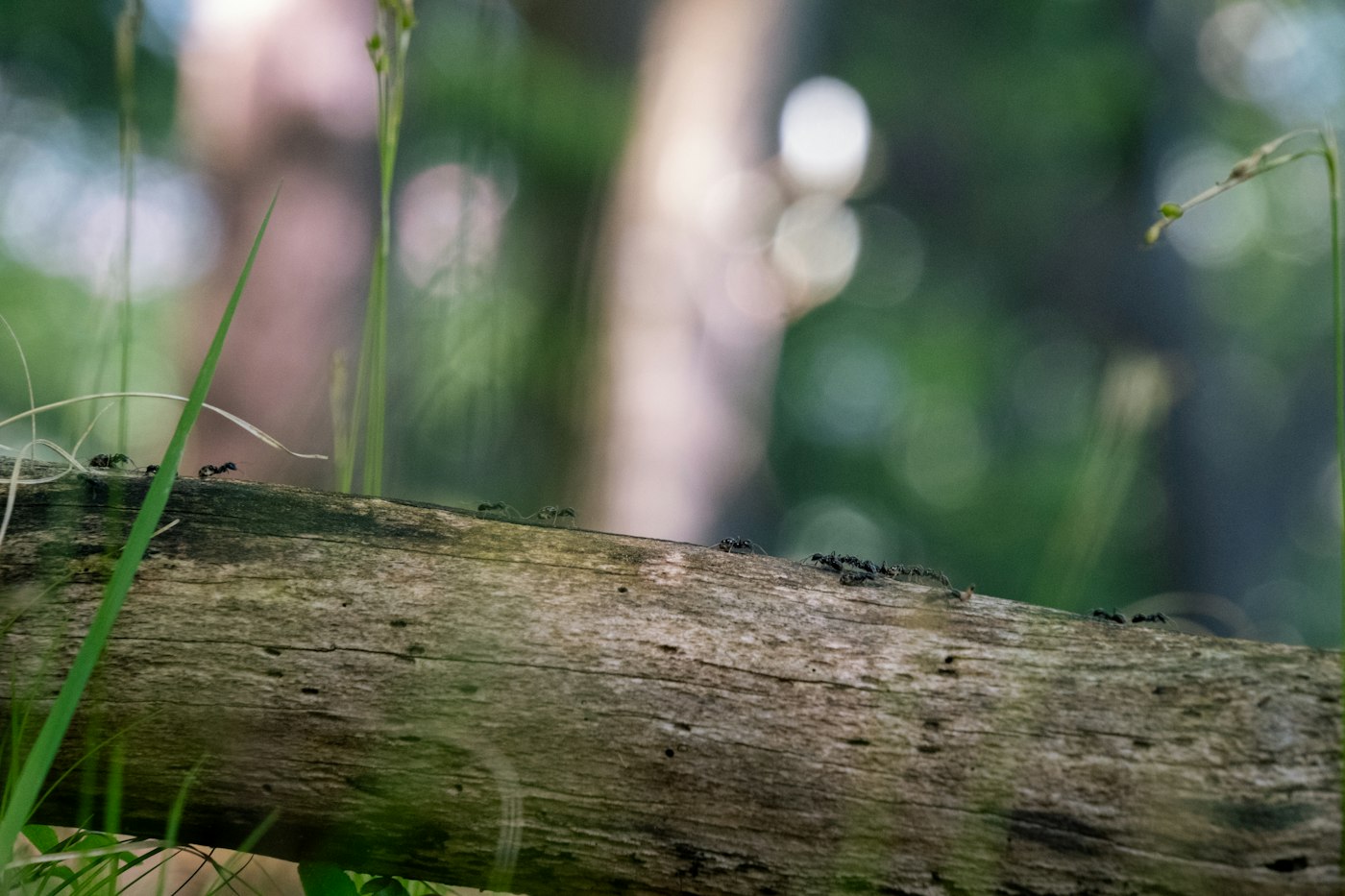
Odorous house ants are the most common call in the county. Crush one and it smells like rotten coconut. They nest in wall voids, under slab edges and in mulch beds, and they move indoors in two situations: after heavy rain floods their outdoor sites, and during a dry spell when they follow condensation lines to water. A colony carries several queens and a ring of satellite nests, which is why a can of contact spray splits it rather than ends it.
Carpenter ants are a moisture problem in disguise. They do not eat wood, they excavate it to nest, and they excavate wood that is already damp: a leaking window sill, a joist under a second-floor bathroom, a porch post standing in a puddle after every storm. Kill the ants and leave the leak, and another colony moves into the same wet timber the following spring.
German cockroaches are a different job entirely. They live in the warm wet walls behind kitchen and bathroom plumbing, within a few feet of water and food, and they need gel bait placed where they harbor, in hinge voids, cabinet corners and under appliances. A perimeter band outside does nothing to them. Two different species, two different jobs, which is why an inspection comes before a product. The reasoning is laid out in full in pest control across Cobb County.
3 Pick your town
Every town here sits on the same red clay, but the houses are not the same age and the water does not sit in the same places.
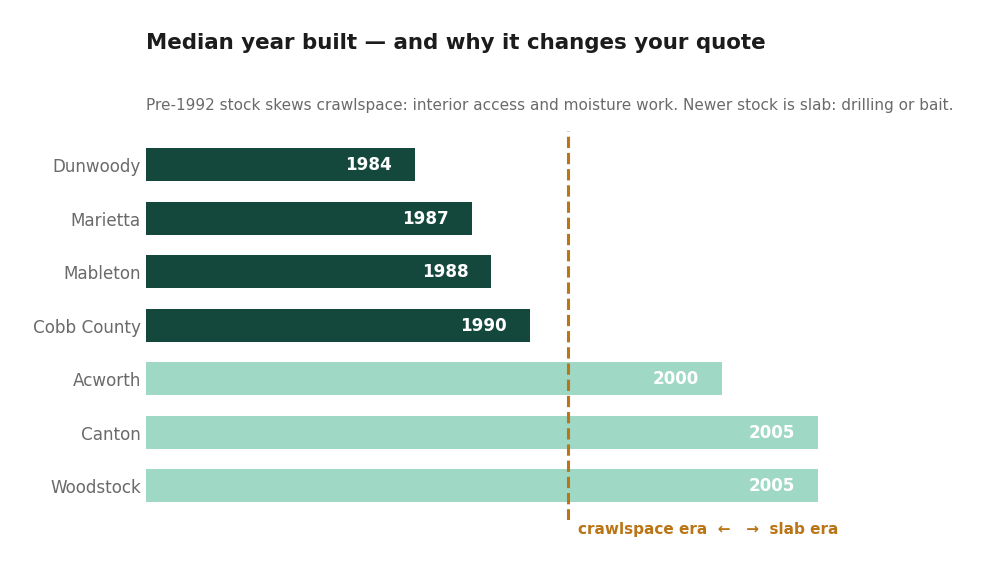
Median build year 1978, and the stock around the Square and west of Roswell Road is older still. Vented crawlspaces, often damp.
Mid-1980s ranches between Nickajack Creek and the Chattahoochee corridor, where clay stays saturated for days after a storm.
Early-1990s subdivisions laid out around detention ponds, with short setbacks and grade running the wrong way on a lot of lots.
Sweetwater Creek and Noses Creek, and houses that have been wet to the floor joists more than once.
Mixed build eras under the Kennesaw Mountain canopy, with leaf litter banked against foundations every autumn.
Lots around Lake Acworth and Lake Allatoona, where sheds, boats and stacked gear give ants a staging area beside the house.
Median build year 1984 under heavy mature hardwood, with north and east walls that never fully dry out.
A split town: old-town frame houses on pier foundations, and new slab subdivisions out toward the Etowah River.
Median build year 2005, slab-on-grade, and mulch beds installed tight against the brick on almost every lot.
4 Where to read next
- The complete guide — what a correct job looks like on Piedmont red clay, how crawlspace and slab homes differ, and the questions that separate a real proposal from a guess.
- Pest control for Marietta’s older housing stock — build eras around the Square and in west Marietta, and what a 1950s crawlspace changes about the work.
- Pest control in Woodstock, GA — the opposite case: 2000s slab subdivisions, shallow footings and landscaping pressed to the wall.
- Talk to a licensed local pro — if you already know what you are seeing and want someone to walk the perimeter.
Start here
The complete Marietta pest control guide
What a correct job looks like on Piedmont red clay, how crawlspace and slab homes differ, and the questions that separate a real proposal from a guess.
Jaylan Jones — Cobb County Pest Solutions publishes independent guidance for North Georgia homeowners. We are a referral service, not a licensed pest control contractor, and we do not perform the work. How we work.

