
Pest control in Marietta › Guides › Wildlife removal in Georgia
Wildlife work is not pest control with a bigger trap. It is governed by state wildlife law rather than by pesticide labels, several of the animals involved are protected, and the part that actually ends the problem is carpentry rather than trapping. This page covers the four species north Georgia homes get most, what the state rules mean for you, and why a job without exclusion is a job you will pay for twice. Start with the complete guide for the wider method.
Ask this first
What species is it, how many entry points did you find, what will you seal them with, and what does the exclusion work warrant? If the answer covers only the animal, the problem is coming back.
1 Which animal, and what the noise tells you
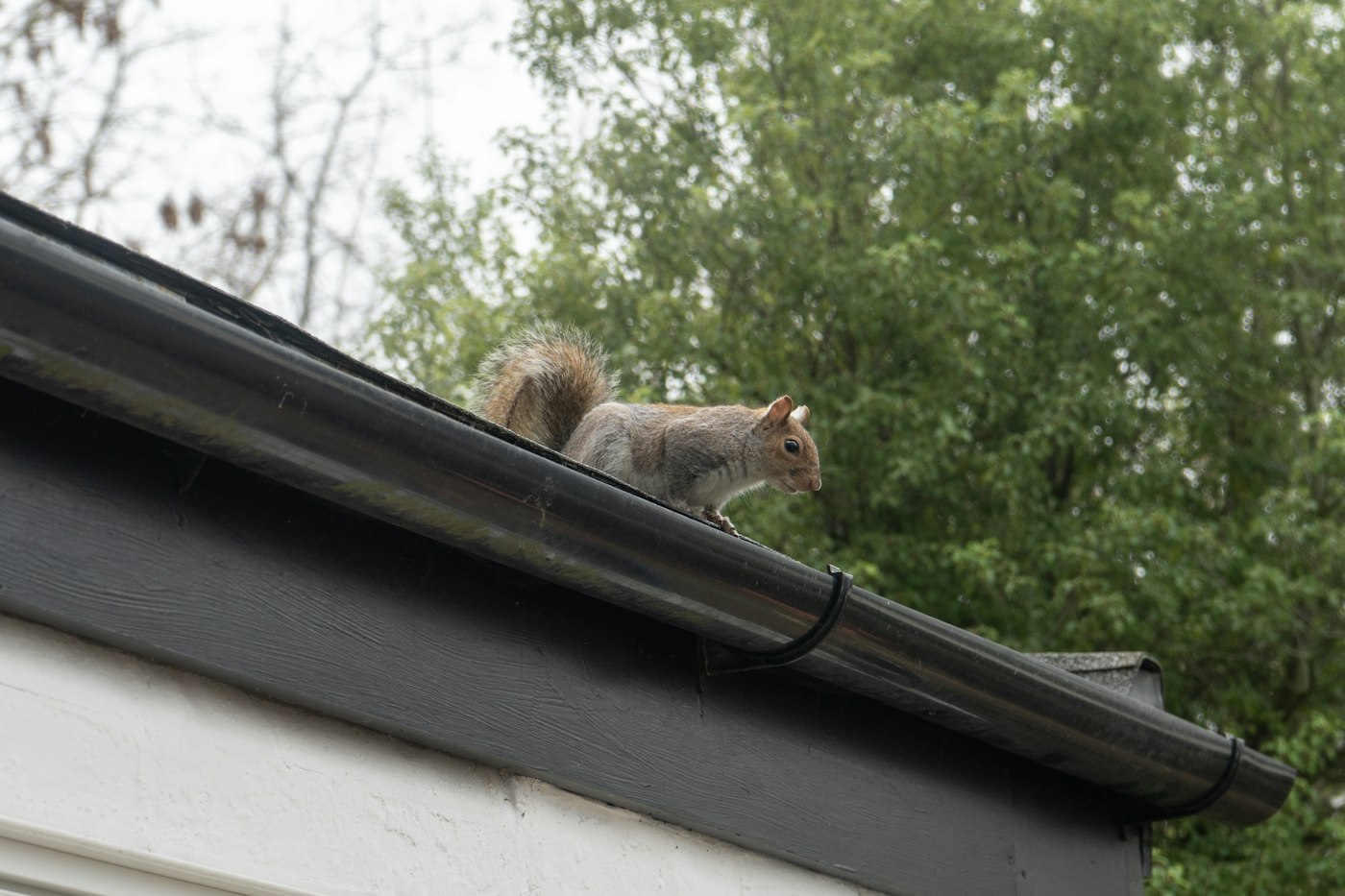
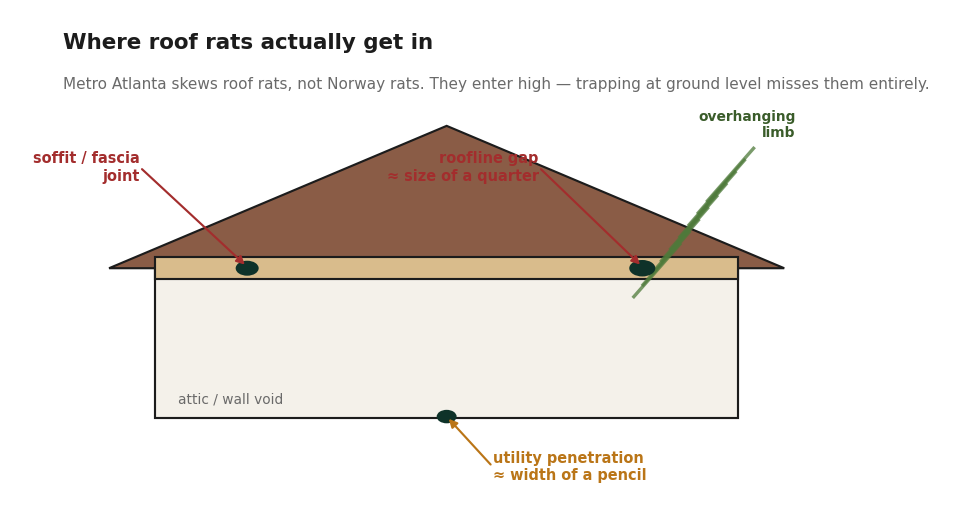
Gray squirrels are the most common attic animal in Cobb County, and the mature hardwood canopy is the reason. A limb overhanging a roof is a bridge, and once a squirrel is on the shingles it works the weak points: the soffit return where the roofline meets the gable, a rotten fascia board, the gap at a roof-to-wall junction, a gable vent with a torn screen. You hear them in daylight, usually early morning and late afternoon, scampering rather than lumbering, and often rolling something across the ceiling.
Raccoons are heavier and nocturnal, and what you hear sounds like a person moving about. A female looking for a den will tear open a soffit, lift a ridge vent or pull back flashing, and in spring you may hear chittering from a litter. Raccoons are a rabies vector species in Georgia, which matters legally as well as practically, and they should never be approached or handled by a homeowner.
Opossums are clumsy, slow, mostly nocturnal, and usually end up under a deck, in a crawlspace or in a garage rather than up in an attic. Bats announce themselves differently: you may see them emerging at dusk from one spot on the house, find dark greasy staining around a gap, or find droppings accumulating below a gable end. Each of those four animals is a different job with different timing and different rules.
2 What Georgia law allows
This is the part that surprises people. Wildlife in Georgia is managed by the Department of Natural Resources, and the rules are not the same as the rules for insects. Handling nuisance wildlife on someone else’s property for payment requires state authorization, and a company doing this work should be able to tell you what it holds without hesitating.
Relocation is the common misunderstanding. Loading a trapped raccoon into a truck and releasing it in a park is not generally lawful in Georgia, and for good reasons beyond the paperwork: relocated animals spread disease into new populations, often die anyway, and simply become another neighborhood’s problem. Rabies vector species are treated more strictly still. The lawful outcomes are narrower than most homeowners expect, and any operator who casually promises to relocate your animal somewhere nice is either misinformed or telling you what you want to hear.
Trapping itself is also regulated, including trap types, how often traps must be checked, and which species may be taken at all. Because the rules change and the details depend on the species and the situation, confirm the current position with the state rather than with a brochure, and ask your operator to put the plan in writing before anything is set. If you want help reading a wildlife proposal, talk to a licensed local pro.
Get the exclusion written as its own line
Entry points found, materials used, warranty on the sealing work. A licensed local crew should list all three.
3 Bats, and why the calendar runs the job
Bats are protected in Georgia and they are never trapped. The only correct method is exclusion: find every opening the colony uses, fit one-way devices so the animals can leave at dusk and cannot return, leave them in place long enough for the whole roost to clear, then seal permanently.
The constraint is the maternity season. Through the warm months, roosts contain pups that cannot yet fly. Excluding the adults then seals flightless young inside the structure, where they die in the wall; it is inhumane, it is not permitted, and it leaves you with an odor problem and a soiled cavity on top of everything else. Exclusion work is therefore scheduled outside that window, which in practice means acting in spring before pups are present or waiting until the young are flying in late summer and early autumn. Any company that offers to seal a bat roost in June should be shown the door.
Two more practical points. Bats fit through remarkably small gaps, so a thorough evening watch to see where they emerge is worth more than any amount of guesswork in the attic. And if there is any chance of direct contact with a person or a pet — a bat found in a bedroom, a child who cannot say whether they were touched — that is a public health question, not a pest question. Contact your doctor and county health department, and do not release the animal, since testing may be needed.
4 Exclusion is the part that ends it
Removing the animal solves today. Sealing the building solves the problem. A gap that let a squirrel in is a gap that will let the next squirrel in, and gray squirrels in particular return to known den sites and will chew their way back to one they remember. Scent left in insulation makes the address more attractive, not less.
Good exclusion work is specific. Every opening gets found, not just the obvious one, because squirrels routinely maintain two or three and a one-way door on the wrong hole achieves nothing. Materials have to be chew-resistant: heavy gauge metal mesh, sheet metal, hardware cloth, properly fastened. Expanding foam and a scrap of screen is decoration. The usual list on a north Georgia house runs soffit returns, gable vents, ridge vents, roof-to-wall junctions, fascia and drip edge, dryer and bath exhaust terminations, plumbing penetrations, crawlspace vents and the crawl access door.
Then there is the landscape. Trim limbs back from the roof, because a canopy that touches the building defeats everything you just paid for. Clear gutters so the fascia stops rotting. Secure the trash can. Take the bird feeder down if it is feeding more than birds. And ask for the exclusion to appear as its own line with its own warranty, because a single bundled number makes it impossible to tell thorough sealing from token sealing. That is the same principle as everywhere else on this site, set out in the Marietta pest control guide.
5 Cleanup, damage and the season
What the animal leaves behind is often the larger half of the work. Droppings and urine soak into insulation and drywall, nesting material is a fire risk near wiring, and squirrels chew wire sheathing and ductwork as a matter of routine. A raccoon latrine in an attic is a genuine health matter and should be handled with proper protection and disposal, not a shop vacuum on a Saturday. Contaminated insulation usually has to be removed, the cavity treated, and new material installed, and that should be scoped and written up separately so you can see exactly what is being done.
Timing runs through the whole subject. Litters are the main reason a removal has to wait: taking a mother out while young are in the attic leaves animals that cannot survive sealed in your ceiling. Rodent pressure rises sharply from mid-October as temperatures drop and leaf litter banks against foundations, which is also the time of year when roof and crawlspace gaps get used. Autumn is the practical moment to walk your own roofline with binoculars and look for the gap before something else does.
One last expectation to set. None of this is covered by a general pest plan. Wildlife is separate work, scoped separately, and that is normal rather than an upsell, as set out in the guide to monthly versus quarterly plans.
Read next
Access, roof height, entry-point count and severity are what a wildlife proposal is really scoping.
Wildlife sits outside general residential agreements. Here is what a plan does and does not promise.
Licensing in Georgia, and why wildlife work answers to different rules than insect work does.
6 Questions
Can I trap a squirrel myself and let it go in the woods?
Relocating wildlife is restricted in Georgia and doing this work for payment requires state authorization. Beyond the law, relocation moves disease, usually kills the animal and hands the problem to someone else. Check the current rules with the Department of Natural Resources before you set any trap.
Why will nobody do my bat work in June?
Because flightless pups are likely in the roost. Sealing the adults out at that point traps the young inside the structure to die in the wall. Exclusion is scheduled before the maternity season or after the young are flying, which generally means spring or late summer into autumn.
Is wildlife included in my quarterly plan?
Almost never. General residential plans cover insects and sometimes rodents. Squirrels, raccoons, opossums and bats are scoped as separate work, and the exclusion and cleanup stages should appear as their own line items with their own warranty terms.
They are gone. Do I really need the insulation replaced?
If it is soiled, usually yes. Contaminated insulation holds odor that attracts the next animal, loses its thermal value once compressed and wet, and in the case of a raccoon latrine carries a genuine health risk. Have it assessed and written up separately so you can see what is being removed and what is going back.
Start here
The complete Marietta pest control guide
What a correct job looks like on Piedmont red clay, how crawlspace and slab homes differ, and the questions that separate a real proposal from a guess.
Jaylan Jones — Cobb County Pest Solutions publishes independent guidance for North Georgia homeowners. We are a referral service, not a licensed pest control contractor, and we do not perform the work. How we work.

