
Pest control in Marietta › Mosquito control › Woodstock
This page covers what mosquito work involves in Woodstock, where the lots are new and small and the thing breeding your mosquitoes is often twenty feet the other side of a privacy fence. Start with the Marietta pest control guide for the whole method, then read this for the local part.
What shapes the job here
How small the lot is and how much of it is treatable once fences and beds are counted, how much the 2005 planting has filled in, the number of downspout extensions, irrigation boxes and drains that hold water, how close the neighboring houses sit, whether the subdivision has common-area drainage, and the interval you pick across the season.
1 A 2005 lot has builder containers
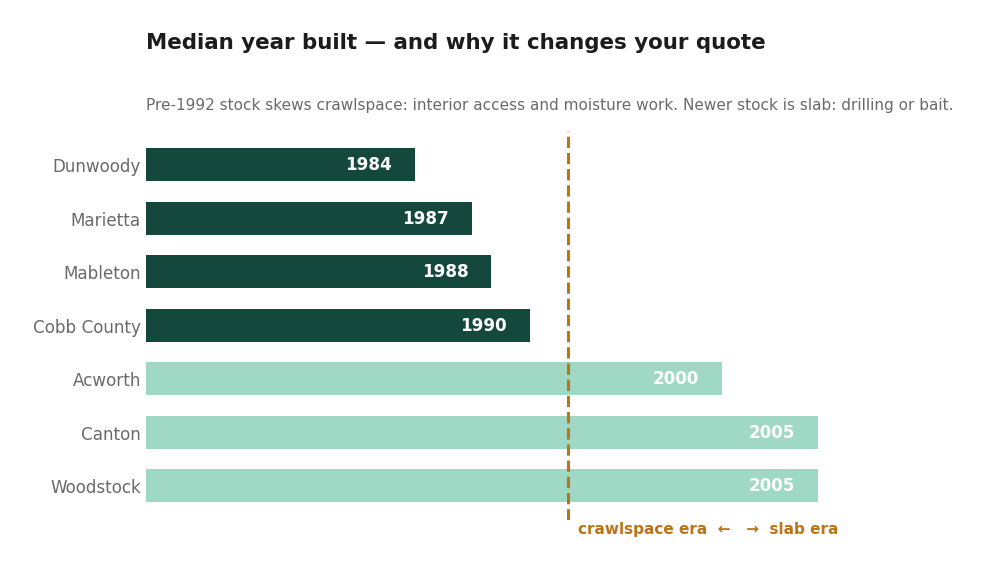
Woodstock has the newest housing stock in this part of north Georgia. Most of it went up between 2000 and 2009 on ground that was cleared and graded first, so you do not get the veteran hardwoods and deep shade that make Kennesaw and Dunwoody difficult. What you get instead is a short, specific list of water-holding items, almost all of them installed by the builder or the landscaper and then forgotten.
Start with the corrugated black downspout extension laid along the bed. Those sag in the middle within a season or two, and a sagging corrugated pipe is a shaded, undisturbed reservoir that holds water for weeks. Then the irrigation valve boxes, which almost always have a few inches in the bottom. Then the shallow landscape drains at the low corner of the yard, silted up and no longer draining. Then the play set with hollow legs and missing end caps, the trampoline frame, the bin with no lid at the side of the garage, and the pot saucers on the patio.
That is good news. On a Woodstock lot the sources are few, man-made and reachable, which means a crew that actually walks the property can usually cut the problem hard in one visit. A crew that pulls up, sprays the back fence line for twelve minutes and leaves has done the easy half of the job and skipped the half that matters.
2 Your neighbor’s yard is part of your yard
In Towne Lake, Bradshaw Farms and the subdivisions off Highway 92, houses sit close together and a good share of the stock is attached townhouses. The Asian tiger mosquito is a weak flier that stays near where it emerged, which on a Woodstock street means the lot next door is comfortably within range. If your back yard is clean and you are still being bitten every afternoon, the honest explanation is usually that the source is on somebody else’s side of the fence.
Privacy fences make it worse in a way people rarely consider. A six-foot board fence on both sides turns the strip along the house into a still, shaded corridor with no air movement, which is exactly where adults rest at midday. The same fence also hides the neighbor’s stack of pots and the paddling pool that has been sitting half full since June.
Two things actually work on these streets. One is treating as a group, or at least getting two or three neighbors to tip their containers in the same week, which is more effective than anything you can buy alone. The other is getting the association to deal with the common-area drainage, the amenity-area bins and the detention basin outfall if your subdivision has one. The reasoning behind both is in the complete guide.
Say how close your neighbors are
On a tight Woodstock lot the boundary matters more than the lawn. A licensed local crew should walk both sides of the fence line with you.
3 Twenty years of planting has filled in
A 2005 subdivision is not a new subdivision any more. The three-gallon shrubs the builder put along the foundation are now dense, and the river birch and maples planted in the front yards have real crowns. Woodstock yards that were wide open fifteen years ago now have genuine shaded resting habitat for the first time, which is why some long-time residents say the biting has got worse without anything obvious changing.
The back of the subdivision is the other thing that has changed. Many Woodstock neighborhoods back onto an undeveloped buffer, a creek corridor or the wooded strip along the Noonday Creek trail, and twenty years of growth has turned those buffers into closed canopy. Where your lot meets that buffer you have permanent shade, damp litter and no right to treat the far side, which puts the honest boundary of the work at your own fence.
Thinning the inside of the overgrown foundation beds helps twice: it removes resting sites, and it lets a technician get a residual onto leaf undersides that were unreachable before. On a small lot that single piece of pruning often does more than adding another visit would.
4 Nearby towns in this hub
Up Highway 575: the same new subdivisions, plus an old town center and the Etowah River corridor.
Same build era, but with two lakes and the boat covers, kayaks and dock gear that come with them.
The opposite problem: battlefield hardwood overhead, tree holes and gutters that never stay clear.
5 Questions
My yard is spotless and I am still being bitten. Why?
On Woodstock lot sizes, a weak-flying container breeder does not have to leave the street to reach you. If your own property is genuinely clear, the source is almost certainly next door or two doors down. Walk the fence line and look over it before you book another treatment.
What is the most commonly missed container on a newer house?
The corrugated downspout extension. It sags within a year or two of being laid, holds water along the sag for weeks, sits in shade under the bed mulch and almost nobody lifts it. Irrigation valve boxes come a close second.
Does the subdivision pond behind my house matter?
Less than people assume. A permanent pond holds fish and predators and makes poor habitat for this species. What matters is the vegetated edge, any trash caught at the outfall, and whether the basin drains properly or leaves shallow pools after a storm. Those are association issues, so raise them there rather than paying for them yourself.
How often does a barrier need renewing?
Roughly every three to four weeks through the April to October season, and sooner after heavy rain or a hard flush of growth. No residual outruns a container that keeps producing, which is why the source walk matters more than the schedule.
Start here
The complete Marietta pest control guide
What a correct job looks like on Piedmont red clay, how crawlspace and slab homes differ, and the questions that separate a real proposal from a guess.
Jaylan Jones — Cobb County Pest Solutions publishes independent guidance for North Georgia homeowners. We are a referral service, not a licensed pest control contractor, and we do not perform the work. How we work.

