
Pest control in Marietta › Termite control › Austell
This page covers termite work in Austell, a low-lying town where water is the controlling variable on almost every job and where a soil treatment has to survive the ground it is placed in. Start with the complete guide.
1 A floodplain town on clay that will not drain
Austell sits where Sweetwater Creek and Noses Creek come together, on some of the lowest ground in the county, and the town has a long and documented history of high water. That is not only a flood question. It is a termite question, because eastern subterranean termites need moisture and Piedmont red clay in the B horizon holds water for weeks after a storm. Georgia is already Termite Infestation Probability Zone 1; a creek-bottom lot in Austell is that condition at full strength.
What it means in practice is that the band of soil a treatment goes into may be wet when the crew arrives and wet again a week later. A good installer accounts for that: they look at where water sits after rain, they check whether the trench will hold, and they tell you which elevations drain and which do not. A crew that treats a saturated low corner exactly the same way it treats the dry street side has not looked at your lot.
Grade is the other half of it. Repeated high water deposits silt, and over years that silt builds the ground up against the foundation. When grade rises above the brick ledge or reaches siding, you have wood near or at soil level, which is a route in that no amount of product in the trench will close.
2 What water leaves behind
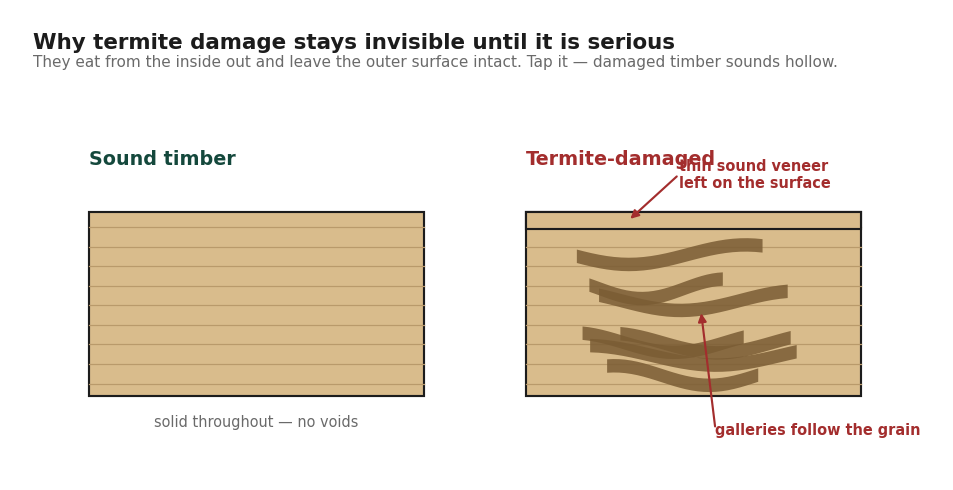
A house that has taken water usually gets repaired in a hurry, and the repairs matter here. Replaced subfloor, sistered joists and new sill sections are fresh untreated lumber sitting in the part of the structure closest to the ground. Crawlspaces that were pumped out hold humidity for months afterward. Vapor barriers get torn and never replaced. Debris washes under the house and stays there.
Major soil disturbance matters too. Trenching for drainage, regrading a yard, or excavating to repair a foundation all break a treated zone that was placed earlier, and nothing about that break announces itself. If serious work has been done around your foundation since the last treatment, the honest answer is that the barrier has gaps and should be reinstated rather than assumed. Background on how the two main methods differ is in the Marietta pest control guide.
Wet lot, old treatment, no paperwork?
That combination is common in Austell and it is worth resolving before March. Start with an inspection under the house.
3 What a correct job looks like on a low lot
The treatment itself is standard: trench against the foundation, rod toward the footing, place a non-repellent termiticide the colony cannot detect so foragers carry it back, backfill with treated soil, and drill through any concrete poured against the house. On a crawlspace home, piers and interior masonry get treated as well, and the technician should be probing framing where tubes were found rather than only treating the dirt.
What changes in Austell is sequence. Water management is not an add-on here, it is the first item: downspouts carried away from the wall, grade cut back so soil sits below the siding and the brick ledge is visible again, vents cleared, a vapor barrier laid and kept intact, and standing water in the crawlspace dealt with. Treat the soil and leave the water and you have bought a retreatment visit. In-ground bait stations are a reasonable option on the sections where a trench will not hold, as long as somebody is contracted to service them.
4 Why a bond beats a one-off here
A single treatment with no bond behind it ends the moment the technician drives away. There is no obligation on anyone if termites turn up again next spring. A retreatment-only bond commits the company to coming back and treating again at no charge. A repair bond commits them to the wood as well. On a creek-bottom lot where the conditions that attracted the colony are permanent, that ongoing obligation is most of what you are buying.
Read the terms with the same attention. Ask for the renewal schedule over the next five years in writing, ask what voids coverage, and ask whether the bond transfers to a buyer. If you sell, the lender will want the Official Georgia Wood Infestation Report, which records visible evidence in accessible areas on the day of inspection only — and a crawlspace that is part water is exactly where a report runs out of accessible area. For help comparing two proposals, talk to a licensed local pro.
5 Nearby towns
Powder Springs sits upstream in the same drainage, on 1990s slabs. Mableton has the same crawlspace moisture problem along Nickajack Creek. Marietta is higher and drier but older. Or go back to termite control across the county.
6 Common questions
The house took water years ago. Does the old termite treatment still count?
Treat it as unknown rather than intact. A treated band lives in the soil, and saturation, erosion, drainage work and regrading all disturb it. Repairs after water damage also put fresh untreated lumber low in the structure. If the ground around the foundation has been worked since the treatment, the sensible assumption is that the zone has gaps and needs reinstating.
My crawlspace stays damp all summer. Where do I start?
With water, not chemicals. Extend the downspouts well away from the wall, make sure the ground falls away from the house, clear the vents, lay an intact vapor barrier over the crawlspace floor and get rid of any standing water. Those steps change the conditions the colony depends on. A treatment placed over an unsolved moisture problem tends to come back as a retreatment call.
The soil has built up against my siding. Does that matter?
A great deal. Siding or framing at or below soil level gives termites a covered route straight past the treated band, and it hides mud tubes from anyone inspecting. On lots that have silted up over the years this is one of the most common findings. Cut the grade back so the brick ledge and the bottom edge of the siding are visible and the ground slopes away.
Is a liquid barrier even workable on wet ground?
Usually yes on most of the perimeter, with judgment applied where a trench will not hold. Timing helps: a dry spell makes for better placement than the week after a storm. Where a section genuinely cannot take a trench, in-ground stations can cover it. What you want on the proposal is a plain statement of which sections get what, and the measured linear footage for each.
Start here
The complete Marietta pest control guide
What a correct job looks like on Piedmont red clay, how crawlspace and slab homes differ, and the questions that separate a real proposal from a guess.
Jaylan Jones — Cobb County Pest Solutions publishes independent guidance for North Georgia homeowners. We are a referral service, not a licensed pest control contractor, and we do not perform the work. How we work.

