
Pest control in Marietta › General pest control › Dunwoody
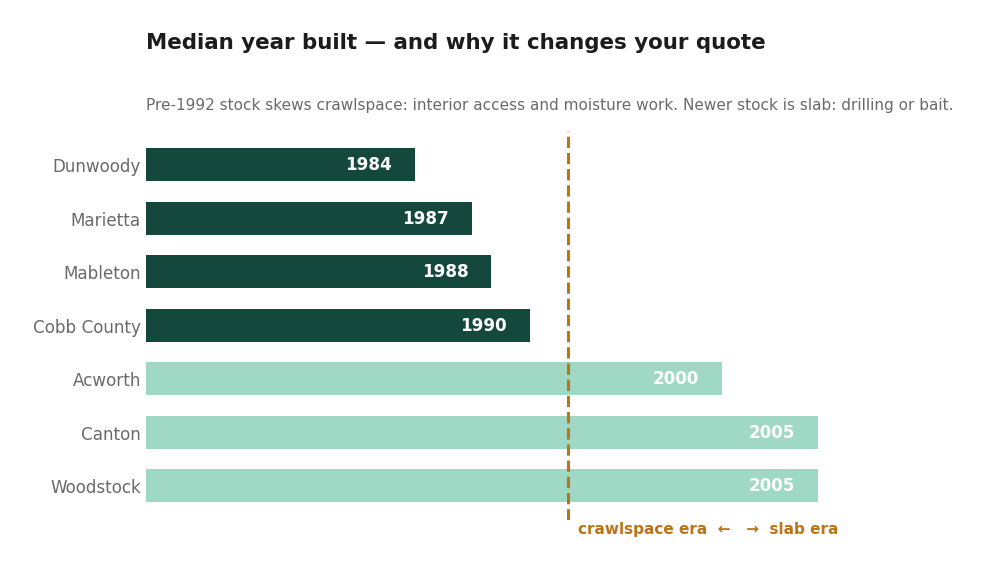
This page covers what general pest work involves in Dunwoody, where a mature tree canopy and an early-1980s housing stock set the terms. Start with the Marietta pest control guide for the whole method, then read this for the local part.
What shapes the job here
Measured perimeter on a house that may have two grade levels, foundation type, how much of the wall sits in permanent shade, access down a steep side yard, the species involved, severity and the cadence you settle on.
1 Built into the woods, not onto a pad
The developers who built Dunwoody out in the 1970s and early 80s kept the hardwoods. Forty years later those oaks, poplars and hickories are full size and standing within a few yards of a lot of foundations. The result is a town where the shaded side of a house can stay damp through a dry week while the sunny side dried before lunch, and where the soil band against the footing holds moisture in Piedmont red clay that drains slowly to begin with.
Three consequences follow. Leaf fall banks litter against the wall every autumn, smothering the exact strip a treatment goes on and giving insects a damp blanket to live under. Gutters pack solid and overflow into the bed below, keeping one corner wet all winter. And limbs lying on the roof or brushing siding bridge any band applied at ground level, which is how ants in spring and rodents in mid-October both get in without crossing it.
None of that is solved with a stronger product. It is solved with a saw, a gutter and a rake, and then a treatment that lands on bare soil instead of on wet leaves.
2 Two grade lines on one house
Dunwoody’s terrain rolls, and a great many houses here were built into a slope with a daylight or walk-out basement at the back. That gives you a foundation where the front is at grade, the back is a full story below it, and the two sides step down between them. For a technician it means the treated line is not a single loop at one height: it climbs, drops and runs behind a retaining wall.
It also means water concentrates. Everything that falls on the upper lawn arrives at the back wall, and if the grade at the walk-out does not fall away briskly, the patio slab and the bottom of the wall stay wet. Add a deck over that patio, which Dunwoody houses nearly all have, and you get a permanently shaded damp box against the structure with a ledger board bolted through the band joist above it.
That ledger is where carpenter ants end up. They do not eat wood; they excavate wood that is already damp, so a carpenter ant call in Dunwoody is a moisture problem in disguise, and the colony is usually within a yard of a flashing detail nobody got right in 1984. For the full argument about fixing the water first, read the complete guide.
Shaded walls, big ants in spring
Mention the basement, the deck and which side never gets sun. A licensed local crew will know where to look first.
3 Which insects, and where
Odorous house ants are the most common call across the whole region and Dunwoody is no exception. They nest in mulch beds and in wall voids, and crushing one gives off a smell like rotten coconut, which identifies them on the spot. They move indoors on weather rather than season: after heavy rain floods their outdoor nests, and again in a dry August when they follow condensation lines to water. A hardware-store spray splits a multi-queen colony into satellites and gives you more trails two weeks later.
German cockroaches are a separate job that shares none of the above. They live in the warm wet walls behind kitchen and bathroom plumbing, within a few feet of food and water, and they need gel bait placed into the harborage itself: hinge voids, cabinet corners, under appliances. An exterior band never touches them, and a repellent baseboard spray scatters them into adjoining voids and makes the next round harder.
Quarterly exterior service is the regional cadence, because north Georgia has no dormant season, only a slower one, and under a closed canopy the ground never dries enough to shorten it further.
4 Nearby towns in this hub
Six years older on the median, and a crawlspace town rather than a basement one.
The other heavily shaded town in this hub, under the Kennesaw Mountain canopy.
Same decade, different problem: crawlspace ranches in the Nickajack Creek bottoms.
5 Questions
Does a finished basement change the inspection?
It hides things, which is the problem. A finished wall covers the band joist and the sill on the lower level, so the inspection moves to what can still be reached: the mechanical room, the rim above the garage, the exterior grade at the walk-out and the deck ledger. Say up front which parts are finished, so nobody reports the house as clear when half of it was never visible.
We have very large trees close to the house. Do they have to come down?
Usually not. What matters is contact and water: limbs off the roof and siding, gutters clear so they stop soaking one corner, and leaf litter raked off the foundation strip. Trimming the bridge and keeping the ground dry gets most of the benefit without touching the canopy that makes the lot worth living on.
Is quarterly service necessary this far into the trees?
It is the regional standard and the shade argues for it rather than against it. North Georgia has no genuinely dormant season, the clay stays damp through winter, and a treated band weathers under rain and irrigation within a few months. A closed canopy keeps the surrounding ground permanently hospitable, so the outdoor population you are holding back never really thins.
Start here
The complete Marietta pest control guide
What a correct job looks like on Piedmont red clay, how crawlspace and slab homes differ, and the questions that separate a real proposal from a guess.
Jaylan Jones — Cobb County Pest Solutions publishes independent guidance for North Georgia homeowners. We are a referral service, not a licensed pest control contractor, and we do not perform the work. How we work.

