
Pest control in Marietta › Guides › Cockroach treatment
Three cockroach species account for almost everything that happens in a north Georgia house, and they are so different from each other that calling them all roaches is the first mistake. One lives outdoors and wanders in. One lives in the canopy and the mulch. One breeds in your kitchen wall and does not leave. The treatment that works for the first two is useless against the third. Start with the complete guide for the wider method, then read this for the species detail.
The thing to look for
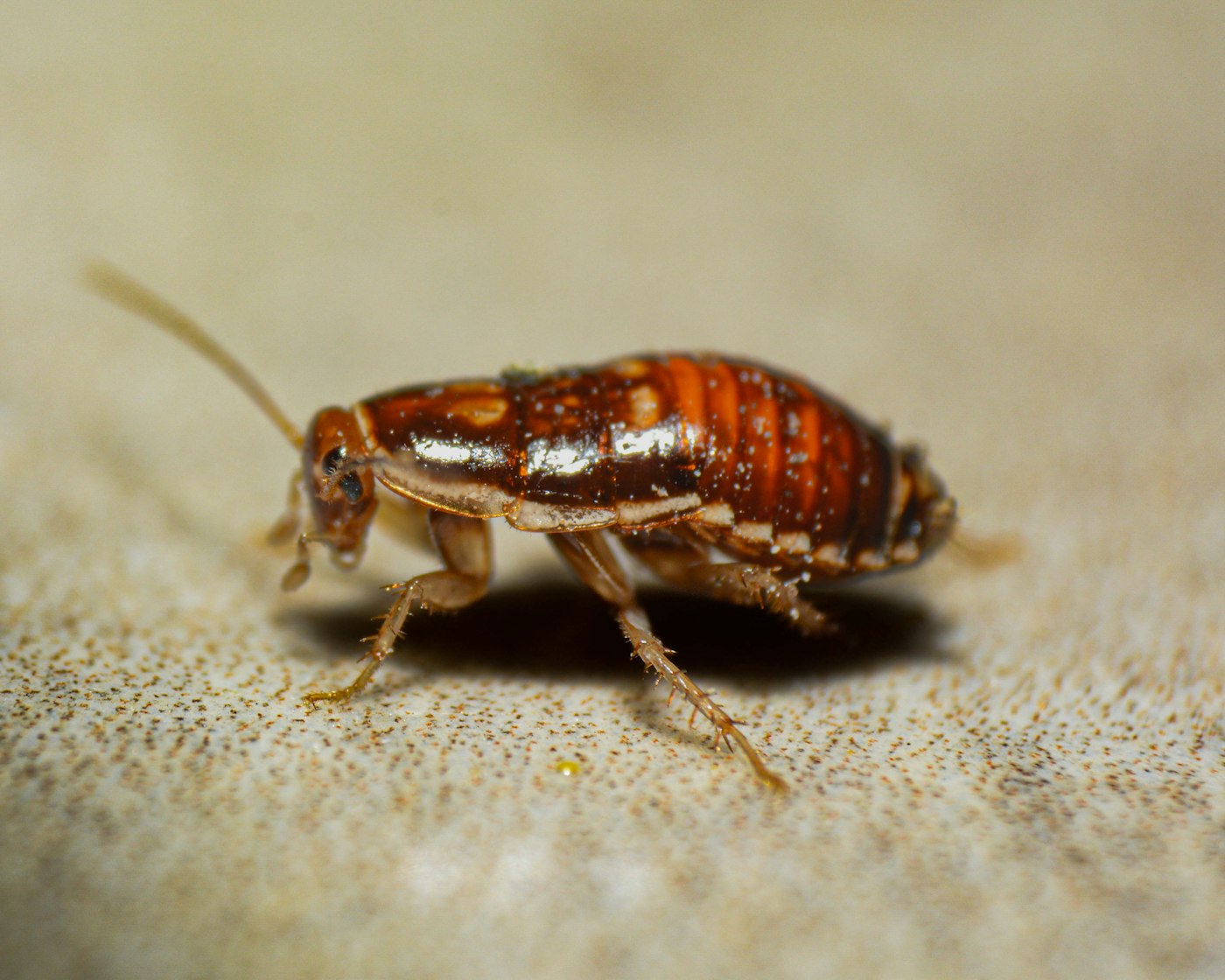
Small roaches, no bigger than a thumbnail, with two dark stripes behind the head. Seeing nymphs of that description near a dishwasher or under a sink means a population is breeding inside the house, not visiting it.
1 Three species, three different problems
The American cockroach is the big one, up to an inch and a half, reddish brown with a pale figure-eight marking behind the head. It is an outdoor animal that happens to find your house. In Cobb County it comes up through floor drains, sewer laterals, crawlspace vents and the gap around a plumbing penetration, and it turns up most often in a basement, a garage or a utility room. A house with a damp crawlspace under it will produce them reliably.
The smoky brown is slightly smaller, uniformly dark mahogany with no markings, and it is a creature of the canopy. It lives in leaf litter, mulch beds, pine straw, tree holes, gutters packed with debris and under loose shingles or siding. It flies well and is drawn to light, which is why you meet it on a porch in August or find one in an upstairs bathroom after a window was open. It dries out quickly, so it clusters wherever humidity stays high.
The German cockroach is a different animal entirely. It is small, light brown, with two parallel dark stripes on the shield behind its head, and it lives its whole life indoors. It does not arrive from the yard; it arrives in a cardboard box, a secondhand appliance, a grocery bag or through a shared wall in a multi-unit building. It breeds fast, it is widely resistant to retail aerosols, and a population established behind a kitchen will not resolve on its own.
2 Where each one harbors
Finding the harborage is most of the job, because every one of these species spends the overwhelming majority of its time hidden and pressed against a surface on two sides. For American roaches that means the crawlspace: the damp soil under a 1970s Marietta ranch, the sill area, the space around a sewer cleanout, a floor drain whose trap has dried out over a dry month. Pour water down an unused drain and you close a door.
For smoky browns, the harborage is the landscape. Mulch piled thick against the brick, pine straw beds, a woodpile stacked on the wall, ivy growing up siding, a gutter full of last autumn’s leaves, the soffit above it. Under mature hardwood canopy those places never dry out, which is exactly what the species needs. The practical consequence is that a smoky brown problem is usually solved in the yard rather than in the house.
German cockroaches harbor in warm, wet, tight voids within a few feet of food and water. The underside of a dishwasher, the motor housing of a refrigerator, the void behind a sink base, the hinge recesses of cabinet doors, the gap where a countertop meets a backsplash, the cavity behind a bathroom vanity, the inside of a microwave’s control panel. If a technician does not pull the kickplate off the dishwasher and look, the inspection did not happen.
German roaches need a protocol, not a visit
A licensed local crew should inspect with a flashlight and a mirror, place gel in the harborage, and schedule follow-ups.
3 Why gel bait beats a perimeter spray for German roaches
A perimeter treatment is designed to intercept things walking in from outside. German cockroaches never go outside, so the band around your foundation is a barrier against a journey they do not make. Everything about the species argues for working inside the void instead.
Gel bait works because the roaches eat it in the harborage and the active ingredient then travels through the population by secondary routes: droppings, regurgitation and cannibalism of dead insects. One bait placement in the right crack reaches insects nobody ever sees. A broadcast spray does the opposite. It is repellent to some degree, so it pushes the population deeper into the structure, spreads a tight cluster into several scattered ones, and contaminates the surfaces where bait should go. Spraying over bait is the single most common way a job is ruined.
Timing is the other half. The egg case, the ootheca, is carried by the female until shortly before hatching and protects the developing nymphs from almost anything applied in the room. That is why a German roach job is a sequence rather than an event: an initial placement, then follow-ups timed to catch each new emergence, with monitors left out to tell you whether numbers are falling. Short service intervals genuinely earn their place here, which is the exception discussed on monthly versus quarterly plans. The same outside-in versus inside-out logic runs through the Marietta pest control guide.
4 Sanitation and harborage reduction
No bait outperforms a kitchen that feeds the population every night. The work that matters is unglamorous: clean under and behind the refrigerator and the range, degrease the area beside the cooktop, empty the toaster tray, keep dry goods in sealed containers, take trash out in a lidded can, pick up pet bowls overnight, and dry the sink before bed. Roaches need water more urgently than food, so a dripping trap or a damp towel left on a bathroom floor matters more than crumbs.
Harborage reduction is the other half. Every crack you close is a nursery removed. Caulk the gap behind the sink base and where the countertop meets the wall, seal around pipe penetrations under cabinets, fit escutcheon plates at supply lines, replace a failed bath seal, and get rid of the stacked cardboard in the pantry, which is both shelter and food. For the outdoor species, the equivalent moves are outside: pull mulch back below the brick ledge, move the woodpile off the wall, clear the gutters, cut ivy off the siding, fit door sweeps, and screen crawlspace vents.
One honest caveat for renters. In a multi-unit building with an established German cockroach population, treating a single unit rarely holds, because the insects move through shared walls, chases and plumbing runs. That is a building-level job and it belongs to the property manager. If you are in that position, document what you are seeing, report it in writing, and talk to a licensed local pro about what a building-wide program should look like.
Read next
When short intervals are genuinely warranted, and what a plan should promise between scheduled visits.
Ants are baited outside where roaches are baited inside, and spraying ruins both for the same reason.
Bed bugs are the other pest that arrives with people rather than from the yard, and preparation decides the result.
5 Questions
Are palmetto bugs the same as cockroaches?
Yes. It is the southern name for the American cockroach, and sometimes for the smoky brown as well. Both live outdoors and come inside by accident, which makes them a far easier problem than German cockroaches. Exclusion, drainage and a perimeter treatment usually settle them.
Does seeing one in daylight mean a heavy infestation?
For German cockroaches it is a bad sign, because they are strongly nocturnal and come out in daylight mainly when harborage is crowded. For American and smoky brown roaches it means less: those species blunder in at any hour, especially after heavy rain floods a crawlspace or a mulch bed.
Why did they come back a few weeks after treatment?
Usually one of three reasons: the first visit was a single event rather than a sequence, so a hatch of nymphs emerged afterward from protected egg cases; somebody sprayed over the bait; or the source is a neighboring unit and keeps reseeding yours. All three are fixable, but they need different answers.
Should I bomb the house with foggers first?
No. Total-release foggers deposit on open surfaces and barely reach the tight voids where roaches live, while the repellent effect pushes the population deeper into wall cavities and splits it up. They also leave residue on the surfaces where bait needs to go, which makes the real treatment harder.
Start here
The complete Marietta pest control guide
What a correct job looks like on Piedmont red clay, how crawlspace and slab homes differ, and the questions that separate a real proposal from a guess.
Jaylan Jones — Cobb County Pest Solutions publishes independent guidance for North Georgia homeowners. We are a referral service, not a licensed pest control contractor, and we do not perform the work. How we work.

