
Pest control in Marietta › Rodent & wildlife removal › Rat and mouse removal in Marietta
This page is about rats and mice in Marietta houses: what the droppings and gnaw marks tell you, why the roof rat is the one you almost certainly have, and what a bait station does and does not do. For squirrels, raccoons or bats, read wildlife removal in Marietta. Start with the complete guide for the whole method.
What shapes the job here
How many openings there are and how high up they sit, the pitch of the roof and whether a ladder reaches the gable, what the seal has to be made of, how long the population has been established, how much insulation and wiring has been damaged, and whether the scope is trapping only or trapping plus exclusion.
1 Read the evidence before you buy anything
Droppings tell you which animal and roughly how many. Mouse droppings are the size of a grain of rice and scattered everywhere, because a mouse goes everywhere. Roof rat droppings are closer to half an inch, pointed at the ends, and they pile along a route rather than spreading out: on top of a ceiling joist, in the insulation beside a run of wire, on a shelf at the back of the garage. A concentrated line of droppings is a highway, and a highway leads to an opening.
Gnawing is the second signal. Rats chew to keep their incisors down, and they leave clean paired grooves on wood, plastic conduit, water line and wire insulation. Fresh gnawing is pale against weathered wood. Rub marks are the third: a greasy dark smear where a body has passed the same corner hundreds of times, usually at the edge of a joist or where a pipe comes through a plate.
Sound separates rodents from everything larger. Rats and mice are quick, light and come in bursts, mostly in the wall cavity and mostly at night. If you are hearing slow, heavy movement, or anything at all at midday, you are listening to something bigger.
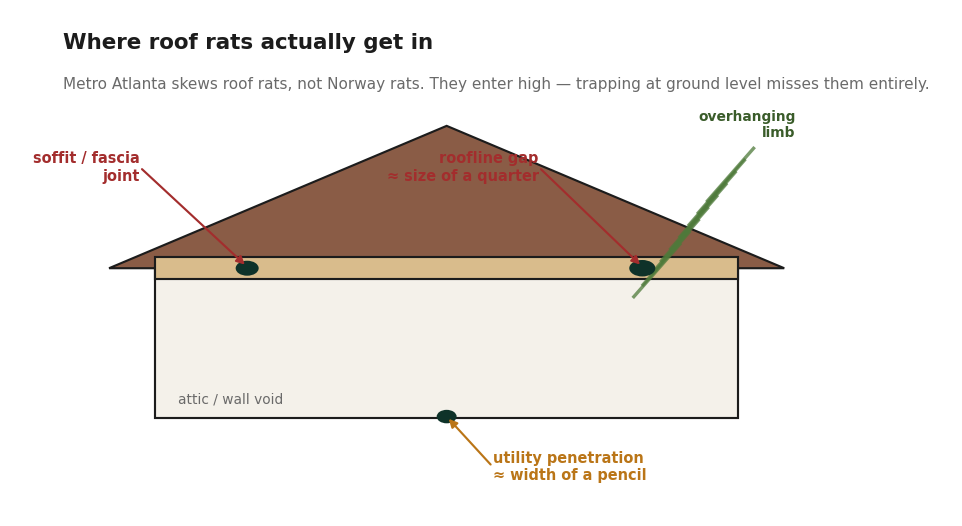
2 Why a Marietta house is a roof rat house
Marietta’s median build year is 1978 and the canopy over those streets has had fifty years to grow into the rooflines. Willow oaks and water oaks lean over the older blocks around the Square and west of Roswell Road, English ivy climbs the trunks and the retaining walls, and along Sope Creek and the other creek lines the woods come up to the back fence. That is roof rat habitat with a heated attic attached.
Roof rats travel above ground by preference. They use limbs, fence tops, ivy, gutters and overhead utility lines, then enter where the 1970s roofline has gone soft: a gable louver whose screen has rusted through, an open soffit return above a carport, fascia behind a leaf-packed gutter. A snap trap on the garage floor never sees them.
The calendar is sharp here. Calls begin the week overnight lows drop, usually in the middle of October. A rat that spent the summer in an ivy bank or a woodpile needs to move twenty feet and upward, and your attic is the warmest thing on the block. That is also why the most useful unpaid hour you can spend is on the limbs: cut the branches back off the roof, pull ivy off the walls, and move the woodpile away from the house.
Droppings in the attic, not on the floor
Say where you found them and how high up. That tells a licensed local crew which part of the roof to put a ladder against.
3 Bait stations, traps and the thing that actually ends it
A tamper-resistant bait station on the outside of the house is a population tool. It knocks down pressure in the yard and it has a place in a long-term program, particularly on a wooded lot where the supply never stops. What it does not do is close an opening, and a station by the back step has no effect on an animal that is traveling a limb into a gable twenty feet up.
Inside an occupied house, trapping is the better instrument. Traps are set on the runs you identified from the droppings and rub marks, not in the middle of the floor, and they give you a body you can count. Bait used indoors sends the animal somewhere dark to die, which in practice means a wall cavity, an odor for two weeks and flies after that.
Neither one ends the job. Exclusion does, and it is not close. Trapping removes what is inside; sealing every opening with material the animal cannot chew is what stops the house refilling next autumn. Galvanized hardware cloth, sheet metal, new wood behind metal, all of it fastened rather than stuffed. Foam and loose steel wool are chewed out. Any proposal that lists trapping and says nothing about sealing is a proposal to repeat the visit in twelve months, and the same logic runs through pest control across Cobb County.
Then comes the part that gets left off: soiled insulation out, the cavity treated, chewed wiring looked at by somebody qualified to look at it. Rodent damage to a wire is a real risk in an attic, not a scare line, and it is worth asking for that check in writing.
4 Nearby towns in this hub
The bigger tenants in the same attic: squirrels, raccoons and bats, and what has to change when there are young up there.
Sweetwater Creek and Noses Creek, where a flood pushes ground-level rodents up and into houses out of season.
Mid-1980s ranches with crawl vents of that era, backed onto the Nickajack Creek and Chattahoochee corridor.
5 Questions
Rat or mouse? How do I tell from the droppings?
Size and distribution. Mouse droppings are about the size of a grain of rice and turn up all over a room. Roof rat droppings are roughly half an inch, pointed, and concentrated along one route. Mice also leave far more of them, because a mouse produces dozens a day.
How small a gap do they actually need?
A house mouse gets through a gap the width of a pencil, roughly a quarter of an inch. A roof rat needs about the diameter of a quarter. On a 1970s Marietta roofline the gap behind a gable louver or at the end of a soffit return is usually far larger than either.
Should I put bait in the attic myself?
No. Bait indoors means animals dying in wall cavities you cannot open, and it does nothing about the opening they came in through. Outdoors, in a tamper-resistant station, bait has a role as part of a program. Inside, traps on identified runs are the right tool.
How long does rodent work take?
An established attic population is usually two to four weeks across several visits, because traps have to be checked and the count has to come down before the last opening closes. Sealing an empty attic ahead of October is often a single visit, which is the argument for doing it in late summer.
Start here
The complete Marietta pest control guide
What a correct job looks like on Piedmont red clay, how crawlspace and slab homes differ, and the questions that separate a real proposal from a guess.
Jaylan Jones — Cobb County Pest Solutions publishes independent guidance for North Georgia homeowners. We are a referral service, not a licensed pest control contractor, and we do not perform the work. How we work.

