
Pest control in Marietta › Mosquito control › Dunwoody
This page covers what mosquito work involves in Dunwoody, where big wooded lots under mature hardwood give the insect more places to rest and more water to breed in than anywhere else in this hub. Start with the Marietta pest control guide for the whole method, then read this for the local part.
What shapes the job here
Lot size and how much of that foliage a crew can genuinely cover, how much mature canopy sits over the house and beds, the state of the gutters and whether anyone will go up to them, the number of rot holes in old trees, how many containers are on your lot and the one next door, and whether source reduction happens before the barrier.
1 A big wooded lot is a big job
Dunwoody’s median build year is 1984, and the neighborhoods of that era were cut into standing hardwood rather than cleared flat. Four decades on, the result is deep shade over most of the lot, dense understorey along the boundaries, and ivy and liriope under the trees. For an insect that spends the hot part of the day resting in cool, humid, shaded foliage, that is the best habitat in the county. It also means the treatable surface on a Dunwoody property is several times what it is on a small, open lot elsewhere.
That has a practical consequence people rarely think about when comparing one visit with another. Putting a residual on the undersides of foliage across half an acre of mature planting takes real time. A technician who is finished in fifteen minutes has treated the parts nearest the drive and walked past the rest. Ask what the visit covers: the whole boundary, under the deck, the ivy bank, the far side of the garage, or just the patio surround.
The canopy also decides your season. Shaded, damp ground under closed hardwood keeps adults active at midday when an open lawn has dried, and it holds that condition later into the autumn. April to October is the county-wide window; on a heavily wooded Dunwoody lot expect the ends to stretch.
2 The gutters are the biggest container you own
On a mature-canopy Dunwoody lot the gutters are almost always the largest breeding site on the property. Oak and hickory litter blocks the run, water sits in a shallow trough along its whole length, and it stays there all summer because the roof is shaded. Nothing applied at ground level reaches it, and most homeowners have never looked. Clearing the gutters before the season starts does more for the biting than any single application will.
Ask a direct question when you book: what happens to the gutters. Some crews treat them as part of the visit, some will drop a slow-release larvicide briquette into a run that cannot be cleared, and some will not go up a ladder at all. That single answer separates a program that works on a wooded lot from one that does not, and it tells you more than anything else in the paperwork.
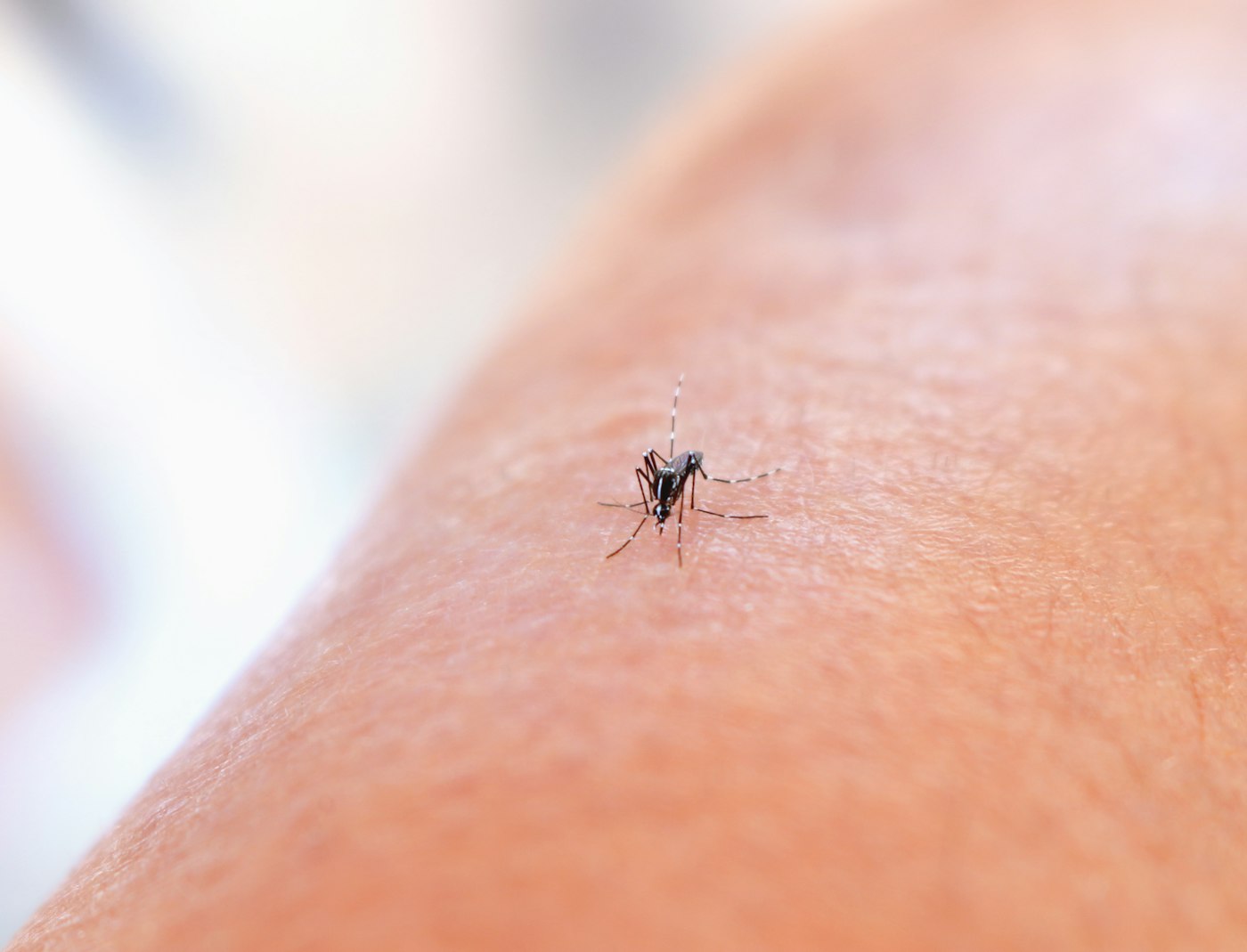
Old trees bring the other container. Where a limb has broken off, the wound forms a pocket that holds rainwater for weeks in deep shade. This species bred in tree holes long before it found tires and pot saucers, and a lot with several veteran oaks has nurseries above head height. A rot hole can be cleared out and filled; it cannot be sprayed from the lawn. Everything here follows the same order, which is set out in the complete guide.
Ask what happens to the gutters
On a wooded Dunwoody lot that one answer tells you whether a program will hold. A licensed local crew should walk the whole property first, not just the patio.
3 This is DeKalb, and the source is close
Dunwoody sits in DeKalb County rather than Cobb, and that matters when you need something official. Contractor licensing is handled statewide by the Georgia Department of Agriculture, the same as everywhere else. But county-level mosquito surveillance, complaints and homeowner guidance run through DeKalb, and questions about species identification or larvicide products go to the DeKalb County Extension office rather than to Cobb’s. Worth knowing before you ring the wrong number.
The second thing to hold onto is flight range. This mosquito rarely goes far from where it emerged, so if your own property is genuinely clear and you are still being bitten, the source is close by: a neighbor’s untended bird bath, an uncovered boat, a stack of pots behind a garage, a wheelbarrow left upright. On Dunwoody’s wooded lots the boundary is often screened by planting, so you may have to walk up and look rather than assume.
That short range is good news. Unlike a regional creek or a stormwater basin, a container next door is a fixable problem and a conversation rather than a contract. Two or three neighbors clearing their water in the same week does more than any of them buying an extra treatment.
4 Nearby towns in this hub
Across the river: 1970s lots where shade comes from grown-in shrub beds rather than from standing hardwood.
The other canopy town, with battlefield park land on the far side of a lot of back fences.
The opposite case: small 2005 lots with little canopy, where the containers are all builder hardware.
5 Questions
Is barrier work alone enough on a wooded lot?
Usually not. A residual on foliage kills the adults it contacts and lasts three to four weeks, but a container-breeding species is producing new adults on your own property in between. In Dunwoody the combination that works is source removal first, barrier second. A crew that only sprays is treating the symptom on a repeating schedule.
My yard is clean and I am still being bitten. Why?
This species rarely travels far from where it emerged, so if your own property is genuinely clear the source is probably just over the boundary. On wooded Dunwoody lots the fence line is often screened by planting, so walk up and look rather than assuming. A friendly conversation with the neighbor often does more than another treatment would.
Can mosquitoes breed in my trees?
Yes. Where an old limb broke off, the wound often forms a pocket that holds rainwater for weeks in deep shade. Tree holes were this insect’s original habitat. On a lot with several veteran oaks it is worth having someone look up as well as down, because a rot hole has to be cleared and filled rather than sprayed.
Dunwoody is in DeKalb County. Does that change anything?
For the work itself, no. For anything official, yes. Licensing is statewide through the Georgia Department of Agriculture, but county mosquito surveillance, complaints and homeowner guidance run through DeKalb, and species or larvicide questions go to the DeKalb County Extension office rather than Cobb’s.
Start here
The complete Marietta pest control guide
What a correct job looks like on Piedmont red clay, how crawlspace and slab homes differ, and the questions that separate a real proposal from a guess.
Jaylan Jones — Cobb County Pest Solutions publishes independent guidance for North Georgia homeowners. We are a referral service, not a licensed pest control contractor, and we do not perform the work. How we work.

