
Pest control in Marietta › Rodent & wildlife removal › Canton
This page covers rodent and wildlife work in Canton, the one town in this footprint where the first question is not what got in but which Canton you live in. Start with the Marietta pest control guide for the whole method, then read this for the local part.
What shapes the job here
Which Canton your house is in, how many openings there are and how high up, roof pitch and ladder access, whether the seal is trim carpentry or masonry, whether young are present, how much insulation is soiled, and whether the scope is trapping only or trapping plus exclusion.
1 The slab subdivisions: everything is at fifteen feet
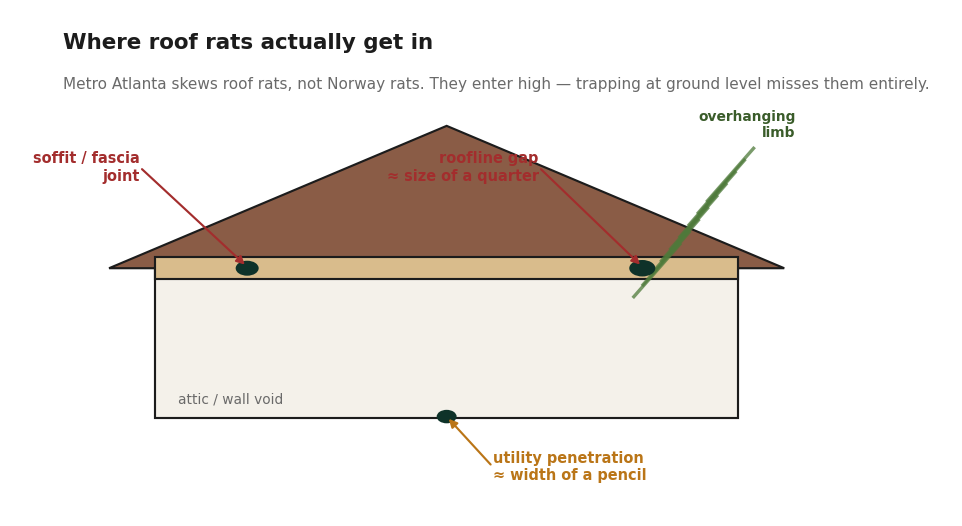
In the post-2000 neighborhoods off Hickory Flat and Univeter there is nothing to inspect at ground level. Slab-on-grade removes the entire crawlspace story that most rodent advice is written around. What is left is the roofline: a ridge cap where the shingle course lifts at the end of a run, an unscreened gable vent, the soffit return where two roof planes meet over a porch, and the dryer, line set and plumbing stack penetrations a builder foamed once in 2004 and nobody has looked at since.
Roof rats and gray squirrels are getting in at fifteen feet, arriving along limbs from the tree save strips and the Etowah River corridor. If somebody proposes exterior bait stations for a Canton slab house with activity in the attic, they are treating a ground-floor problem you do not have. The right first question is which opening they found and where, and on a house this age a crew that has actually been up a ladder can name it.
2 The historic core: entry at the ground, noise at the top
The pre-1940 houses around the old mill district are a different building altogether. They sit on fieldstone and brick pier foundations, and a century of weather has taken the mortar out of the joints. These are not gaps the width of a pencil; they are openings you can put a hand through, opening into unconditioned cellars.
What makes it awkward is balloon framing. In a house of that era the wall cavities run uninterrupted from the foundation to the attic, so a mouse that comes in at grade has a clear vertical route to the roof without ever crossing a living space. Homeowners hear movement overhead, go looking at the roofline, and the entry is forty feet below where they are standing. Downtown, the inspection starts at the foundation and works up.
The repair is different too. Closing a stone pier opening is masonry rather than trim carpentry, and it needs to breathe where the cellar needs ventilation, which means hardware cloth bedded into the work rather than a smear of mortar across a hole. Ask whether the person proposing it does that work themselves or subcontracts it. The general method is set out in the complete guide.
Say which Canton you are in
Downtown stone piers or a 2005 slab off Hickory Flat. That one answer decides whether a licensed local crew starts at the foundation or on a ladder.
3 Sealing is the work; trapping is the clearing
Trap to clear what is inside, then seal — and the sealing is what ends it. Trapping on its own treats the symptom: the opening is still there in spring and something else uses it. A proposal that is trapping with a recurring monthly charge and no closing work attached is a subscription to the same problem.
Order matters. Seal everything but the main run, get the animals out by trap or one-way door, and close the last opening only once the attic or cellar is empty. Seal first with young behind the wall and the mother opens a new hole, which in a balloon-framed downtown house can mean a bay you then have to open from inside. Material matters just as much: galvanized hardware cloth and sheet metal, fastened, not foam and not loose steel wool.
One administrative note people get wrong here. Canton is Cherokee County, not Cobb, so county codes, extension guidance and inspection resources come out of the Cherokee County office in Canton rather than Marietta. A fair number of operators quote Cobb assumptions at a Cherokee address.
4 Nearby towns in this hub
South down the river, and all one era: 2005 builder hardware with no historic core to complicate it.
West, where the supply is lake shoreline timber and the yards are full of stored boats.
Back in Cobb, with battlefield canopy next door and three build eras on one street.
5 Questions
Is my Canton house a roofline job or a foundation job?
Build year decides it. Post-2000 on a slab, which is around 40 percent of Canton housing, means the entry is almost certainly at the roofline: gable vents, ridge ends, soffit returns or a utility penetration. Pre-1940 in the downtown core, on fieldstone or brick piers, means you start at grade, because balloon framing turns a ground-level entry into an attic noise.
I hear them above me. Does that not mean they came in at the top?
Not downtown. An uninterrupted wall cavity carries an animal from the cellar to the attic without it ever being seen, so where you hear it tells you where it ended up, not where it got in. That is the single most common wasted inspection in the historic core.
Should I trap first or seal first?
Both, in that order, with one opening left working until the animals are out. Trapping clears the house, sealing keeps it clear. Neither alone does the job, and sealing before the attic is empty is how litters end up inside walls.
When should the work be booked?
Before the first real cold snap. Calls begin the week overnight lows drop, usually in the middle of October, and every crew’s calendar fills behind it. Sealing in September means the work is finished before the pressure arrives rather than during it.
Start here
The complete Marietta pest control guide
What a correct job looks like on Piedmont red clay, how crawlspace and slab homes differ, and the questions that separate a real proposal from a guess.
Jaylan Jones — Cobb County Pest Solutions publishes independent guidance for North Georgia homeowners. We are a referral service, not a licensed pest control contractor, and we do not perform the work. How we work.

