
Pest control in Marietta › Termite control › Canton
This page covers termite work in Canton, a town with two completely different kinds of house and two completely different scopes of work to match. Start with the Marietta pest control guide.
1 Two Cantons, split by the river
Canton’s median build year is 2005, which makes it one of the newest towns in this hub. That figure hides the part that matters. A small but real share of the housing here predates 1940, and it is concentrated in the old mill town beside the Etowah River — frame houses on brick piers, high vented crawlspaces, original heart pine framing, and nearly a century of additions.
Everything else went up in the 2000s on the ridges and rolling ground above the river, as slab subdivisions with pretreated soil under the concrete. So the same phone call from two Canton addresses can describe two unrelated jobs, and a company that gives both the same scope has not read either house. Georgia is Termite Infestation Probability Zone 1 across the board, and Piedmont red clay holds moisture long after a storm whichever side of town you are on.
Canton is in Cherokee County rather than Cobb, which does not change the rules. Georgia licenses structural pest control statewide through the Department of Agriculture, and a company treating your house for hire has to hold a company license with a certified operator in that category.
2 The old core: piers, heart pine and additions
A pre-war Canton house on piers is the easiest kind of house to read and one of the harder ones to treat. Easy to read because you can get underneath, see every pier and spot a mud tube climbing from the soil to the sill long before the floor tells you anything. Harder to treat because the perimeter is rarely one clean line: an original footprint, a kitchen added in the fifties, a back porch enclosed in the eighties, a concrete stoop poured over what used to be steps.
Each of those joints is a place a previous treatment stopped. On a house this age the treatment history is usually unknown and the products used decades ago are not in use now, so nothing from then is protecting anything today. The crawlspace is the other half of the job: grade, vents, a vapor barrier, and where water goes when it rains. Fix those and the treatment holds. Skip them and you are booking a return visit.
Old core or new subdivision?
The answer changes the whole scope of work. Get the foundation walked and measured before anyone writes a proposal.
3 The subdivision house: slab, pretreatment and time
A 2000s Canton house was pretreated before the slab went down, and then the soil around it was trenched for irrigation, cut for a patio, dug for deck footings and regraded at least once. The pretreatment is twenty years old, the bond that came with it has usually expired, and in most cases it did not transfer when the house changed hands. Being new is not coverage.
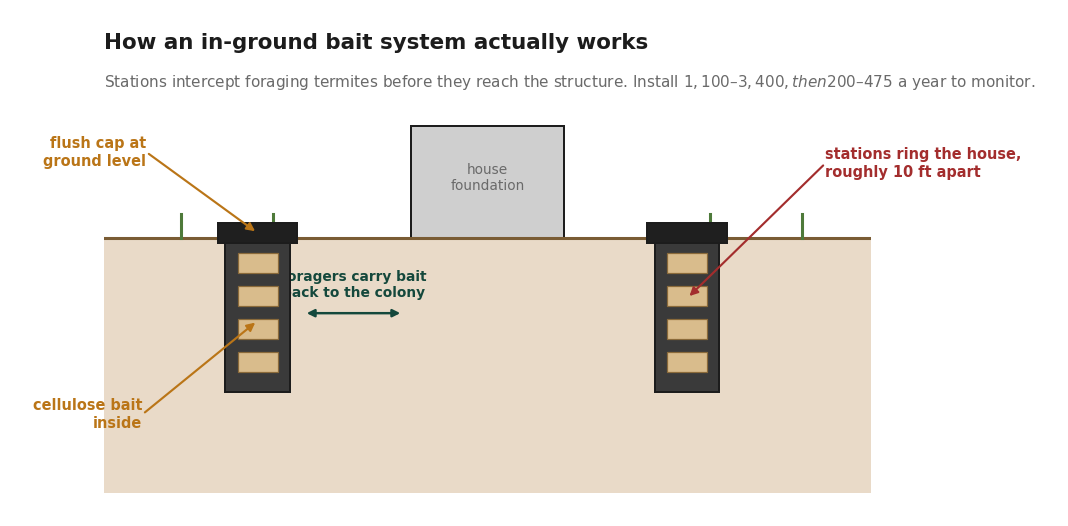
Retreating a slab house means trenching and rodding where there is soil, and drilling through the garage apron, stoop, patio and any concrete poured against the wall to inject underneath. The product used is a non-repellent termiticide the colony cannot detect, so foragers pass through the treated band and carry it back. The zone has to be continuous, which is why an untreated section is a gap rather than a shortcut. On tight lots where hardscape eats most of the perimeter, in-ground stations cover the rest. Both methods are compared in the complete guide.
4 Bonds, labels and the questions worth asking
A retreatment-only bond commits the company to coming back and treating again at no charge. A repair bond commits them to repairing the damaged wood as well. On an old pier-and-beam house with original framing, the repair tier is doing far more work than it appears to. Ask which one you are being offered, ask for the renewal schedule over the next five years in writing, ask what voids coverage, and ask whether the bond transfers to a buyer.
Canton skews young, with a lot of households that have small children and pets, and the reasonable question that comes with that is what is actually being applied. Ask for the product label before the work starts. The label is the legal document that states how the product is used, where it may be placed and what re-entry interval applies, and any licensed operator should be able to produce it. At closing, the Official Georgia Wood Infestation Report records visible evidence in accessible areas on the day of inspection and nothing more. When you want a second read on a proposal, talk to a licensed local pro.
5 Nearby towns
Woodstock is the same build era without the old core. Acworth adds lake water and a shallow water table. Kennesaw mixes eras under heavy canopy. Or go back to termite control across the county.
6 Common questions
Our downtown house is over a hundred years old. Is the framing already gone?
Not necessarily. Old heart pine is dense and plenty of these houses are structurally sound, but subterranean termites eat along the grain and leave the surface intact, so damaged wood can look fine until it is probed. That is the job of a proper crawlspace inspection: sounding and probing sill, band joist, joist ends and piers rather than looking at them from the hatch.
Is the product safe around children and pets?
That is a question for the product label, not for a sales conversation. Ask the company which product they intend to use and ask to see the label before work begins. It states where the product may be placed, how it is applied and what re-entry period applies. A licensed operator will have it on hand; anyone who will not show it has told you something useful.
We are buying a 2006 house here. What should the inspection cover?
Ask whether a current bond exists, who holds it and whether it transfers. Then have the slab house inspected properly: baseboards and trim on the garage wall, slab penetrations under sinks and the water heater, the brick ledge all the way round, and the expansion joint at the garage. A clean Wood Infestation Report at closing covers what was visible that day, which on a finished slab house is a narrow slice.
When should we book, given swarm season?
Swarmers fly March through May, and that is when everyone calls at once, so inspections book out. Feeding, though, goes on all year on red clay. Booking in the quieter winter months gets you a careful inspection and a crew that is not working against a queue, and it puts any treatment in place before the spring swarm rather than after it.
Start here
The complete Marietta pest control guide
What a correct job looks like on Piedmont red clay, how crawlspace and slab homes differ, and the questions that separate a real proposal from a guess.
Jaylan Jones — Cobb County Pest Solutions publishes independent guidance for North Georgia homeowners. We are a referral service, not a licensed pest control contractor, and we do not perform the work. How we work.

