
Pest control in Marietta › General pest control › Powder Springs
This page covers what general pest work involves in Powder Springs, where most of the housing came out of the early-1990s subdivision boom. Start with the Marietta pest control guide for the whole method, then read this for the local part.
What shapes the job here
Measured perimeter, foundation type, how much of that perimeter a technician can get a wand to past a fence line six feet from the wall, soil moisture, the species present, how far it has spread and the cadence you choose.
1 Subdivisions built around a pond
Powder Springs filled in during the early 1990s, right when county stormwater rules made a detention pond standard at the low end of a development. Those ponds are the defining pest feature of the town. Each one holds a shallow pool, a permanently damp fringe and a band of rank vegetation, and each one is fed by graded swales that run between houses. Lots along the swale line sit on ground that never fully dries, even in a dry July.
Thirty-odd years of settlement has made it worse. Builder grading on red clay compacts and slumps, and a swale cut in 1992 is often now a flat run or, on a few lots, a slope back toward the house. Fence lines went in afterwards, right up against the property line, which means a technician trying to treat the side wall may have four or five feet to work in with a gate he has to be handed a key for.
So the first thing worth asking a company in this town is whether they can actually reach your whole perimeter, and what they do about the stretch they cannot.
2 Slab edges and the ants under them
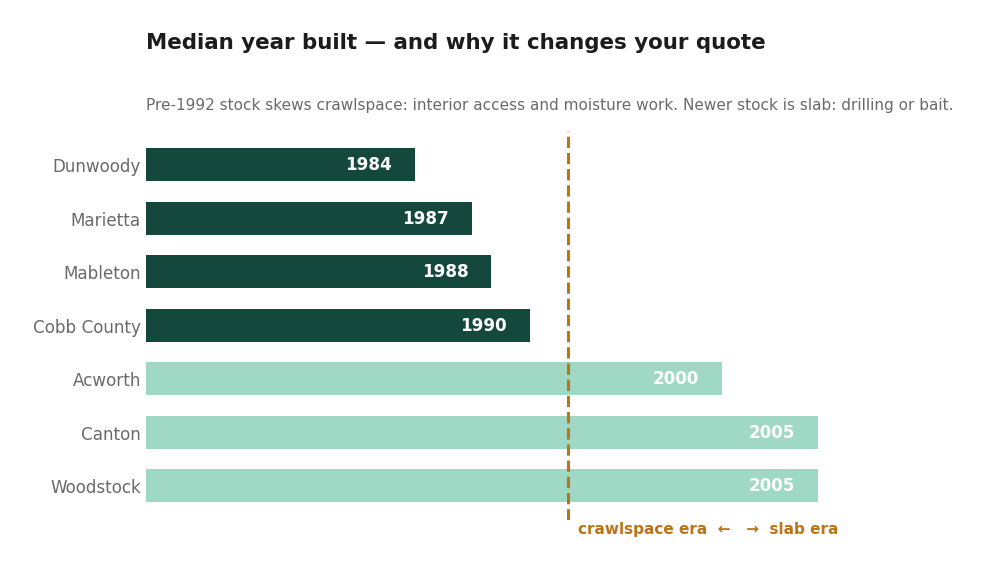
The early 1990s were the changeover decade in Cobb County. Powder Springs has both foundation types, often on the same street, and the difference matters. On a slab, the gap between the slab edge and the brick veneer is a continuous sheltered run around the whole house, and odorous house ants treat it as a highway. They nest in the mulch bed and in the void behind the veneer, and they enter around the sill, under door thresholds and at utility penetrations.
Crush one and it smells of rotten coconut. That smell is worth knowing, because it tells you what you are dealing with before anyone arrives. Their colonies carry several queens and a ring of satellite nests, so a can of contact spray from the hardware store splits the colony rather than ending it, and you get more trails in more places two weeks later.
They move indoors on a schedule set by the weather, not the season: after heavy rain floods their outdoor nests, and in a dry spell when they follow condensation lines to water. On a lot near a detention pond, the rain route gets used a lot. Quarterly exterior service is the regional cadence because north Georgia has no dormant season, only a slower one, and a band laid in March is weathered thin by July.
Same ants, every spring
Say which way your lot drains and how close the pond is. A licensed local crew can tell you whether the fix is product or grade.
3 Carpenter ants and the 1990s deck
Nearly every house of this era got a pressure-treated deck off the back, and most of those decks are now on their second or third life. The ledger board bolted into the band joist is the weak point: flashing was often skipped, water tracks behind it, and the band joist stays wet. Carpenter ants do not eat wood, they excavate it to nest, and they excavate wood that is already damp. A carpenter ant call in Powder Springs very often ends at a deck ledger or a porch post standing in a puddle.
That makes it a moisture problem in disguise. Treat the ants and leave the water, and another colony takes the same timber next spring. A proposal worth signing names the conducive condition by location. For the argument behind that order of work, read the complete guide.
German cockroaches are the separate case. They live in the wet walls behind kitchen and bath plumbing and need gel bait placed in the harborage itself. An exterior band does nothing to them, however well it is applied.
4 Nearby towns in this hub
Downstream neighbor on Sweetwater and Noses Creek, with real flood history rather than pond fringe.
Mid-1980s crawlspace ranches in the Nickajack bottoms, a decade older than most of Powder Springs.
Mixed build eras, but the pressure comes from canopy and leaf litter rather than stormwater.
5 Questions
Our subdivision pond is managed by the HOA. Can anything be done about it?
The pond itself is the association’s, and a contractor treating your lot has no standing there. What you can control is the hundred feet between the pond and your wall: keep the swale clear, keep mulch below the brick ledge, extend downspouts past the bed, and cut back the rank growth along your own line. Those changes are usually worth more than anything applied to the pond edge.
My side yard is only a few feet wide. Does that matter?
Yes, and it is one of the real variables in a Powder Springs job. A fence close to the wall, an air conditioning pad, a gate that stays locked and a bed built up against the brick all reduce how much of your perimeter actually gets treated. Ask what happens to the stretch behind the condenser and behind the fence, because that is usually where the trail you keep seeing originates.
Is quarterly service really necessary here?
It is the regional cadence, and the reason is weather rather than sales. There is no genuinely dormant season in north Georgia, the clay holds moisture through winter, and a treated band breaks down under rain, irrigation and sun in a matter of months. Near a detention pond you have a permanent outdoor reservoir of insects, so the interval matters more than it would on a dry ridge lot.
Start here
The complete Marietta pest control guide
What a correct job looks like on Piedmont red clay, how crawlspace and slab homes differ, and the questions that separate a real proposal from a guess.
Jaylan Jones — Cobb County Pest Solutions publishes independent guidance for North Georgia homeowners. We are a referral service, not a licensed pest control contractor, and we do not perform the work. How we work.

