
Pest control in Marietta › Termite control › What a termite bond is
A termite bond is the document that decides what happens if termites turn up in a house somebody has already treated. This page covers the two kinds, the limits written into both, who can hold one, and the ordinary homeowner decisions that quietly cancel one. Start with the complete guide for how the treatment itself works.
Why Georgia homeowners end up with one
Georgia is Termite Infestation Probability Zone 1, the highest tier on the national map, and Piedmont red clay keeps the soil damp enough for eastern subterranean termites to forage all year. Most homeowner policies exclude termite damage outright, so for a great many houses the bond is the only thing standing behind the structure.
1 It is a contract, not a policy
The word bond makes people think of insurance, and that is the first thing to let go of. There is no insurer. There is a pest control company that has treated your house and has agreed, in writing, to keep inspecting it and to come back under defined conditions. The strength of the promise is the strength of the company making it.
That matters practically. A commitment to repair structural damage is only as good as the firm that wrote it, so who you sign with is not a separate question from what you are signing. Ask how long they have worked in north Georgia, who performs repairs under the bond, and what happens to existing agreements if the business changes hands.
A bond attaches to a treatment and a property, not to you. It describes a specific structure, treated a specific way on a specific date, and most of its terms exist to protect the condition of that treatment. That is why so many of the obligations land on the homeowner rather than the company.
2 Retreatment only, or retreatment and repair
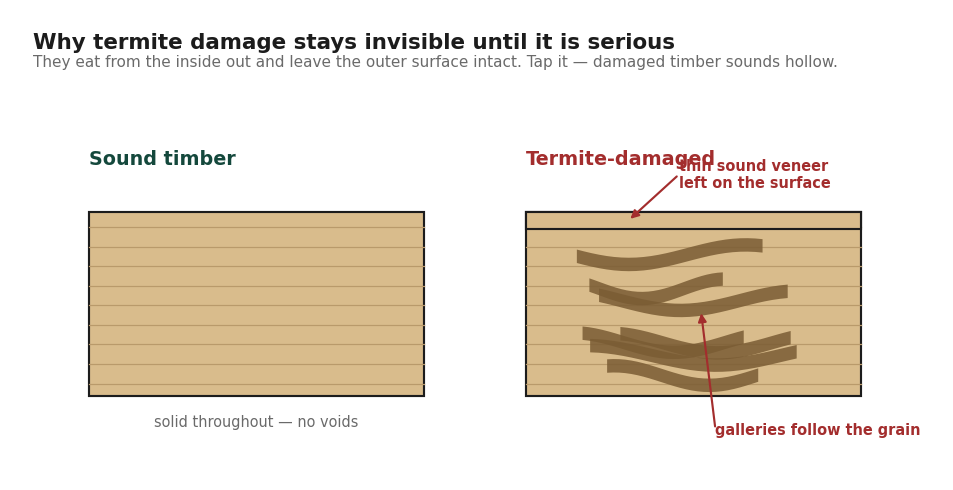
A retreatment-only bond says that if termites return to the structure during the term, the company comes back and treats again at no additional charge to you. That is the whole commitment. If the colony has eaten part of a floor joist in the meantime, the carpentry is yours to arrange and yours to carry.
A repair bond adds a commitment to make good the damage caused by termites after the treatment date, up to a limit stated in the contract. The limit is a real number written on the document, and it varies enormously between companies and between tiers of the same company. Read it, because repair coverage with a modest limit and repair coverage with a generous one are sold under the same two words.
Which one you are offered usually depends on what the inspection found. A house with existing damage, poor crawlspace access, wood-to-soil contact or a chronic moisture problem may be offered the retreatment tier only, or the repair tier once conditions are corrected. That is a reasonable position, and it tells you something about your house worth hearing.
Ask which tier you are being offered
And ask why. The answer is usually a description of your own foundation that nobody else will give you.
3 Limits and exclusions
Every bond has boundaries, and they are not hidden so much as unread. The limit on a repair commitment is the obvious one. Beyond it, look for these.
Pre-existing damage
Damage that existed before the treatment is almost always excluded, which is why the initial inspection report matters so much. Anything the inspector recorded as existing damage sits outside the commitment permanently. Make sure that list is accurate before you sign, because you cannot argue it later.
Inaccessible areas
A bond covers the structure the company was able to inspect and treat. Where the crawlspace was too tight to enter, where a porch could not be drilled, where a finished basement wall hides the sill, the contract usually says so in a schedule of excluded or untreated areas. In Georgia, low crawlspace clearance is the common one.
Species and structures
Many agreements cover subterranean termites and nothing else, which leaves drywood termites, powderpost beetles and wood-decay fungus outside. Some contracts name Formosan termites as an exclusion. Detached garages, sheds, decks and fences are frequently outside the covered structure unless they are listed. There is also commonly a waiting period at the start, during which the commitment is not yet in force.
4 Transferability
Most Georgia bonds can move to a new owner and almost none move on their own. The contract names the mechanics: notice to the company within a window around the sale, a form signed by the buyer, sometimes an inspection, often an administrative charge. Miss the window and the agreement can simply end at closing, which is one of the quietest losses in a house sale.
Read what survives the transfer, not just whether it transfers. A repair commitment held by the seller sometimes becomes retreatment only in the buyer’s name, and a waiting period may restart. A builder bond on a newer slab house may have lapsed years ago unnoticed, so in a post-2000 subdivision ask for the document rather than the reassurance.
For a buyer, the bond and the inspection history together are worth more than either alone. The termite letter describes one day; the bond describes who is standing behind the house. More on how those two documents differ is in the Marietta pest control guide and in the pages below.

5 What voids one
Almost everything that voids a bond is something a homeowner does for a perfectly good reason. The treated soil band is the thing being protected, so any work that disturbs it puts the agreement at risk: a deck footing, a French drain, a new patio, a regraded bed, a sprinkler trench, a retaining wall, landscaping dug in along the foundation. None of it is forbidden. It simply has to be disclosed so the affected stretch can be retreated.
Missing the annual inspection is the second and the most common. A company cannot stand behind a structure nobody has looked at, so a skipped visit or a lapsed renewal generally ends the obligation rather than pausing it. Leaving a written-up conducive condition uncorrected can have the same effect: standing water in the crawlspace, a chronic leak, wood-to-soil contact, firewood against the wall.
Treatment by another company is the one people do not expect. If a second firm treats the structure, the original company’s commitment usually ends, because they can no longer vouch for what is in the soil. The rule of thumb is simple enough: before anybody digs, builds or sprays around your foundation, call the company whose name is on the bond. If you need help finding a licensed company in the first place, start here.
Keep reading in this topic
What the renewal maintains, what a lapse ends, and how reinstatement works.
The termite letter is not a bond and not a warranty. What it does and does not say.
Every bond sits on top of a liquid barrier or a bait system. How each one works.
6 Questions
Is a termite bond the same as a termite letter?
No. The termite letter, formally the Official Georgia Wood Infestation Report, is a one-time inspection document produced for a property sale. A bond is an ongoing contract with the company that treated the house. Holding a bond does not remove the need for the letter at closing, which surprises a lot of sellers.
What does a claim under a repair bond actually look like?
You report activity, the company inspects and confirms it, they retreat, and the repair side is then assessed against the contract: damage caused after the treatment date, in a covered area, within the stated limit. Expect the company to use its own contractor. Keep every inspection report, because the record of what was found when is what the assessment rests on.
Do I need one on a newer slab house?
It is the weakest case, and it is still Zone 1. A post-2000 slab home with clean drainage and no wood-to-soil contact is a harder target, and many were pretreated at construction. Check whether that builder agreement still exists and whether it transferred to you, since those lapse silently at resale more often than not.
What should I keep in the file?
The signed bond with its schedules, the original graph or diagram of the structure, the treatment record naming the product and the measured footage, and every annual inspection report since. That folder is what a claim, a sale or a second opinion is argued from.
Start here
The complete Marietta pest control guide
What a correct job looks like on Piedmont red clay, how crawlspace and slab homes differ, and the questions that separate a real proposal from a guess.
Jaylan Jones — Cobb County Pest Solutions publishes independent guidance for North Georgia homeowners. We are a referral service, not a licensed pest control contractor, and we do not perform the work. How we work.

