
Pest control in Marietta › Termite control › Woodstock
This page covers termite work on Woodstock’s slab-era housing: what the builder did before the concrete went down, what is left of it now, and what a retreatment looks like twenty years on. Start with the complete guide.
1 The newest housing stock in the region, and why that is not protection
Woodstock built out later than anywhere else in this hub. The Towne Lake side and subdivisions like Bradshaw Farms sit in a tight 2000s band, which gives the town a very particular termite profile: almost entirely slab-on-grade, almost no vented crawlspaces, and a lot of houses whose only termite treatment to date was a soil pretreatment sprayed before the slab was poured.
That pretreatment was real work and it did its job. It is also twenty-odd years old, and it was placed under a slab that has since been trenched for irrigation, cut for a patio extension and backfilled around a deck footing by three different crews. Builder bonds attached to those houses have usually expired, and they tend to lapse quietly at resale rather than transferring to the new owner. Plenty of Woodstock homeowners believe they are covered by paperwork that stopped applying in 2012.
Being new is not the same as being safe here. Georgia is Termite Infestation Probability Zone 1, the highest tier in the country, and a 2005 slab on Piedmont red clay is sitting on the same year-round foraging pressure as a 1970s crawlspace in Marietta. It just will not tell you about it.
2 Slab homes hide everything
On a crawlspace house you get a warning: mud tubes climbing a pier, visible from underneath, often years before the damage matters. A slab house gives you nothing. Subterranean termites come up through an expansion joint, a plumbing penetration, a settlement crack or the cold joint where the garage slab meets the foundation wall, and they travel inside the wall cavity. The first sign is frequently a soft baseboard, a door frame that gives under a thumbnail, or a line of discarded wings by a sliding door in April.
That changes what a good inspection looks like. On a Woodstock slab the inspector should be sounding baseboards and trim on the garage wall, checking the sill area where brick veneer meets the foundation, looking at every slab penetration under sinks and water heaters, and walking the exterior grade for mud tubes bridging from soil up over the brick ledge. An inspection that is just a walk around the yard is not an inspection. For background on how this compares with the rest of the metro, read about pest control in Marietta.
Is your builder bond still in force?
Most Woodstock homes from the 2000s build band are no longer covered by anything. Find out before swarm season, not during it.
3 Treating a slab after the fact
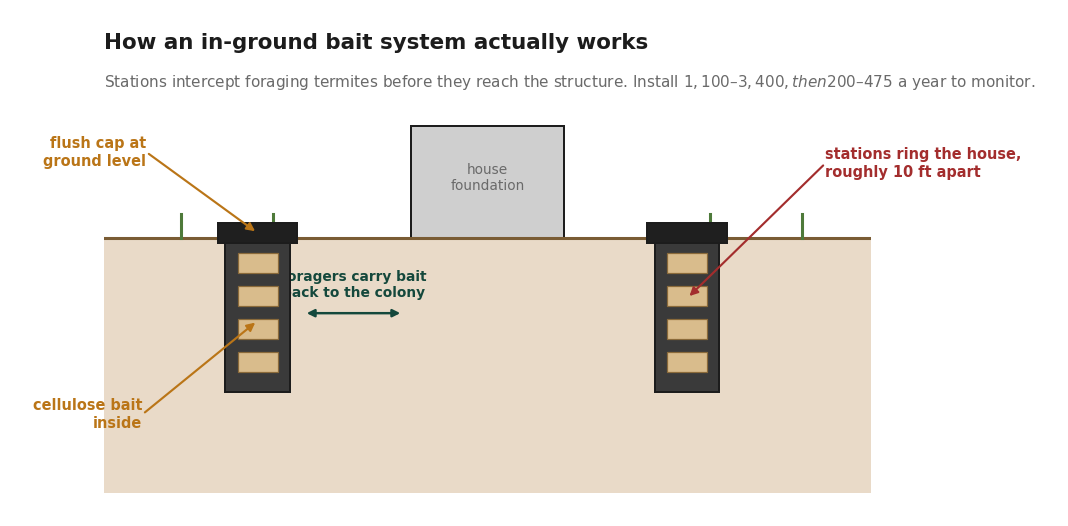
A post-construction liquid treatment on a slab house is two operations. Where there is soil against the foundation, the crew trenches and rods and places a non-repellent termiticide so the termites walk through it, carry it back and share it with the colony. Where there is concrete against the foundation — the garage apron, the front stoop, a wraparound patio, a driveway poured tight to the wall — they drill on a set spacing, inject beneath the slab and patch the holes.
On a Woodstock lot the ratio of drilled concrete to open trench is usually the single biggest difference between two houses on the same street. A three-car garage, a large rear patio and a stamped-concrete walk mean a lot of drilling and a long day. In-ground bait stations are the common alternative where the diggable perimeter is too short to make a continuous liquid zone worth the effort, and plenty of houses here end up with both. Whichever you choose, ask for the measured linear footage on the proposal; without it there is nothing to compare.
4 What the bond actually says
A retreatment-only bond means the company returns and treats again at no charge if termites turn up, and nothing more. A repair bond means they also pay to repair the damaged wood. In a slab house, where damage usually announces itself only after it has reached the framing, the gap between those two documents is wider than it looks. Ask which one you are signing, ask what the renewal schedule looks like over the next five years, and ask whether the bond transfers to a buyer.
At closing a lender will want the Official Georgia Wood Infestation Report. Understand what it is: a record of visible evidence in accessible areas on the day of the inspection. On a slab house with finished walls, that is a small fraction of the structure. A clean report is useful and it is not a warranty. If you want a second read on a proposal, talk to a licensed local pro.
5 Nearby towns
Canton is split between old-town pier foundations and new slab subdivisions. Acworth adds a shallow water table from the lakes. Kennesaw mixes build eras under heavy canopy. Or go back to termite control across the county.
6 Common questions
My house was pretreated when it was built in 2004. Do I still need anything?
A pre-slab soil pretreatment is not permanent, and the ground around the house has been disturbed many times since: irrigation trenching, a patio pour, deck footings, landscaping, utility work. Each one can break the treated zone. The bond that came with the pretreatment has almost certainly expired, and in most cases it did not transfer to you when you bought. Treat 2004 as a starting date, not a guarantee.
Will drilling the garage slab damage it?
Done properly, no. The holes are small, placed on a regular spacing along the inside of the foundation wall and through the cold joint, and patched afterwards. You will see the patches. If a crew proposes to skip the garage because of the finish, understand what you are agreeing to: the garage cold joint is one of the most common entry routes into a slab house, and leaving it out leaves a gap in the treated zone.
Bait stations or liquid on a tight Towne Lake lot?
It depends on how much of the perimeter is actually soil. If patio, walk and driveway take up most of it, a continuous liquid zone becomes mostly drilling, and stations around the remaining soil can make more sense. The catch with bait is that it is slow and it only works while somebody is servicing it. If you move to bait, confirm the service interval in writing and keep the records.
I found wings on the windowsill in April. What now?
Discarded wings indoors mean reproductives emerged inside the structure, which points to an established colony already in contact with the house. Collect a few in a bag so the inspector can confirm termite rather than flying ant, and get the full perimeter inspected rather than just the room where you found them. March to May is swarm season here, and inspections book out during it.
Start here
The complete Marietta pest control guide
What a correct job looks like on Piedmont red clay, how crawlspace and slab homes differ, and the questions that separate a real proposal from a guess.
Jaylan Jones — Cobb County Pest Solutions publishes independent guidance for North Georgia homeowners. We are a referral service, not a licensed pest control contractor, and we do not perform the work. How we work.

