
Pest control in Marietta › Termite control › Marietta
This page covers what termite work looks like on a Marietta house: the foundation you probably have, what a crew should do to it, and the bond you are left holding afterwards. Start with the Marietta pest control guide.
1 Why Marietta sits in the harder half of the county
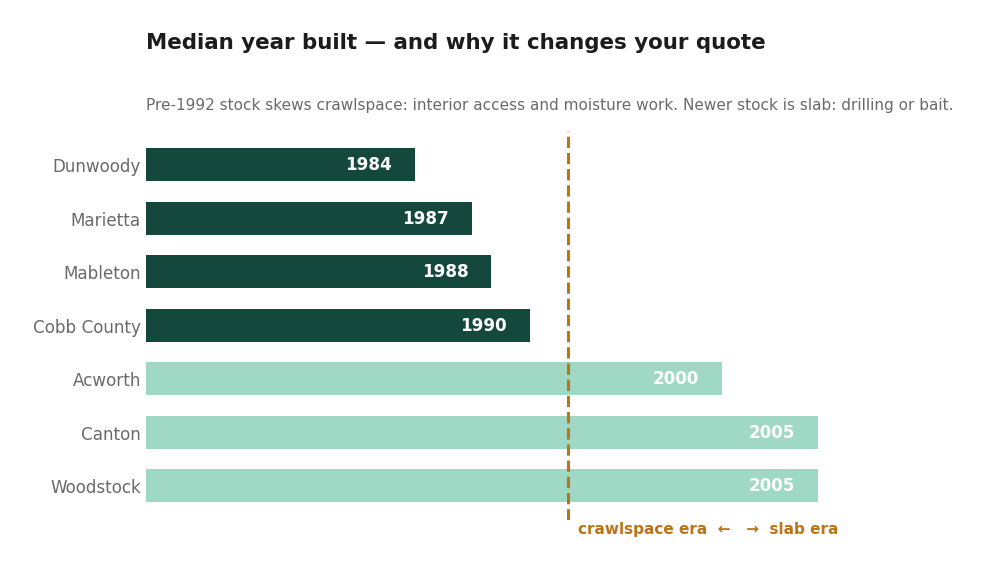
Marietta’s median build year is 1978. That one number tells you most of what you need to know: brick ranches and split-levels on vented crawlspaces, with piers you can walk between and a sill plate sitting close to grade. Crawlspace homes are the honest ones. They show you mud tubes climbing a pier before the damage gets structural.
East of town toward Sope Creek the lots are shaded and the ground is slow. Piedmont red clay in the B horizon holds water for weeks after a storm, far longer than the sand south of the fall line, and a crawlspace over wet clay stays humid into the summer. That extended moisture window is exactly what lets eastern subterranean termites forage here all year rather than seasonally. Georgia is Termite Infestation Probability Zone 1, the highest tier in the country, and Marietta’s older, damper half is the part of the county that earns it.
Around the Square the stock is older still, and much of it has been added to in stages: a sunroom here, a carport enclosed there. Every addition is a joint where a previous soil barrier stopped. Newer infill and the subdivisions further out sit on slabs instead, which hide everything until a baseboard goes soft.
2 What the crew should actually do
A liquid soil barrier is a trench against the foundation, rodded down toward the footing, charged with a non-repellent termiticide, then backfilled with treated soil. Where concrete meets the house — porch, stoop, patio, garage apron, driveway up against the wall — the crew drills on a set spacing and injects underneath. Inside the crawlspace, piers and any supporting masonry get treated too. Non-repellent means the termites cannot detect the product, so they walk through it, carry it back and share it.
All of that only works if the treated zone is continuous. The common failures in Marietta are a deck the crew would not dig under, a retaining wall on a sloped lot, and mature foundation shrubs nobody wanted to cut back. An untreated run is a door, not a saving. If a section truly cannot be reached, it belongs on the proposal in writing. In-ground bait is the alternative where digging is impractical: stations ringing the house, a growth regulator carried back to the colony, and a slower result that depends entirely on somebody servicing the stations on schedule. If you want help reading two proposals against each other, talk to a licensed local pro.
Get the perimeter measured first
Any termite proposal written without a linear-foot number on it is a guess about your house.
3 The bond is the part you keep
The treatment is a day. The bond is the next ten years. A retreatment-only bond says that if termites come back, the company treats again at no charge to you — and stops there. A repair bond says they also pay to put the wood back. On a 1970s crawlspace house with original floor joists, that difference is the whole point of signing anything.
Two things to settle before you sign. First, renewals escalate; ask for the renewal schedule for the next five years in writing rather than taking the first-year figure as the shape of things. Second, ask whether the bond transfers to a buyer, and what the company charges to transfer it. Marietta turns over, and a live transferable bond with an unbroken treatment history is a genuine asset in a closing file — and the Official Georgia Wood Infestation Report the lender wants only records visible evidence in accessible areas on the day of the inspection. It is not a clean bill of health for the parts nobody could see.
4 March to May, and what you will actually see
Swarmers fly March through May, usually on a warm afternoon after rain. Indoors you rarely see the swarm itself — you see what it leaves: a scatter of identical discarded wings along a windowsill, a sliding door track, or a basement stairwell. Outside, look low on the foundation and on crawlspace piers for pencil-width mud tubes running up from the soil. A colony producing reproductives has usually been feeding for several years already.
Swarming is seasonal. Feeding is not. On red clay the colony works through the winter, which is why an inspection in January is worth as much as one in April and is far easier to book. For the countywide picture across every pest, read pest control across Cobb County.
5 Nearby towns
Kennesaw mixes eras under the mountain canopy. Mableton is mid-1980s stock in the Nickajack Creek corridor. Dunwoody is close in age to Marietta but sits under far heavier hardwood canopy. Or go back to termite control across the county.
6 Common questions
I found mud tubes on two piers in my crawlspace. Is the whole house infested?
Not necessarily, but you cannot tell from two tubes. Subterranean termites forage out from a soil colony along whatever route is wettest and easiest, so tubes on the shaded north side of a Marietta crawlspace often mean the colony is working that side first. The inspection has to cover the full perimeter and every pier, because the treatment is sold by the foot and written against the whole foundation, not the spot where you happened to look.
Does a termite bond transfer when I sell?
Often, but it is never automatic and it is not identical between companies. Some transfer on request, some charge a transfer fee, and some require a fresh inspection before they will carry the bond over to a new owner. Ask for the transfer clause in writing before you sign, and keep every treatment and renewal record together — a bond with a gap in its history is worth much less at closing.
The Georgia Wood Infestation Report came back clean. Am I covered?
You are covered for what the inspector could see. The Official Georgia Wood Infestation Report documents visible evidence in accessible areas on the day of the inspection. A sealed crawlspace corner, wood behind finished basement drywall, or framing buried under insulation is not part of that. Read the limitations section on the form itself; it says so plainly.
Liquid or bait on a 1970s Marietta crawlspace?
Usually liquid, because the perimeter on that kind of house is mostly diggable soil and the crawlspace gives real access to piers. Bait earns its place where a trench is impractical — heavy hardscape, a finished walkout basement, a well close to the house, or a lot where the grade will not hold a trench. Plenty of Marietta houses end up with liquid on the open runs and stations where the crew could not dig.
Start here
The complete Marietta pest control guide
What a correct job looks like on Piedmont red clay, how crawlspace and slab homes differ, and the questions that separate a real proposal from a guess.
Jaylan Jones — Cobb County Pest Solutions publishes independent guidance for North Georgia homeowners. We are a referral service, not a licensed pest control contractor, and we do not perform the work. How we work.

