
Pest control in Marietta › Rodent & wildlife removal › Wildlife removal in Marietta
This page is about the larger attic occupants in Marietta — squirrels, raccoons and bats — and what changes when they have young up there. If it is rats or mice you are hearing, read rat and mouse removal in Marietta instead. Start with the Marietta pest control guide for the whole method.
What shapes the job here
How many openings there are and how high they sit, the pitch of the roof and whether a ladder reaches the gable, what material the seal has to be, whether there are young in the nest, how much insulation is soiled, and whether the scope is trapping only or trapping plus exclusion.
1 Tell what is up there before anyone sets a trap
Sound and timing identify the animal more reliably than anything else a homeowner has to work with. Gray squirrels are active in daylight, loudest in the first hour after sunrise and again before dusk, and they sound like something rolling a nut across the ceiling. Raccoons move at night, slowly and heavily, and you hear weight rather than speed. Bats are nearly silent and give themselves away by a rustle at the eave at dusk and droppings on a wall below one spot.
That matters because each one is a different scope of work. A squirrel is removed and the opening is closed. A raccoon is usually a female that chose your attic as a den and will defend it, and she has to leave with her litter. Bats are protected and the timing of any exclusion is restricted during maternity season, which is a legal limit on the work rather than a sales line.
Tell whoever you call three things: what you hear, when in the day you hear it, and which part of the house it is over. Those three answers get you an inspection aimed at the right part of the roof.
2 Marietta’s canopy and a 1978 roofline
Marietta’s median build year is 1978, and the stock around the Square and west of Roswell Road is older than that. What those decades have in common is a mature hardwood canopy grown up over them: willow oaks and water oaks on the older streets, and along the creek lines in east and south Cobb a continuous band of hardwood that runs right up to the back of the lot. A squirrel does not have to climb your brick if a limb puts it on the shingles.
The rooflines of that era then give it somewhere to go. Gable louvers with a thin screen stapled behind them, and fifty years of weather on the staples. Boxed soffit returns over a carport or a porch roof, open to the attic because nobody ever closed the back of the box. Wood fascia behind a gutter that has been holding leaves since the trees matured, soft enough to be opened in one afternoon. Houses near Sope Creek and the battlefield edge get the heaviest pressure, because the woods next door never run out of animals.
This is also the reason the highest-value thing you can do yourself has nothing to do with the attic. Cut the limbs back off the roof. A gap in a gable six feet from a branch is a door; the same gap with nothing within ten feet of it is mostly decorative. The broader reasoning sits in the complete guide.
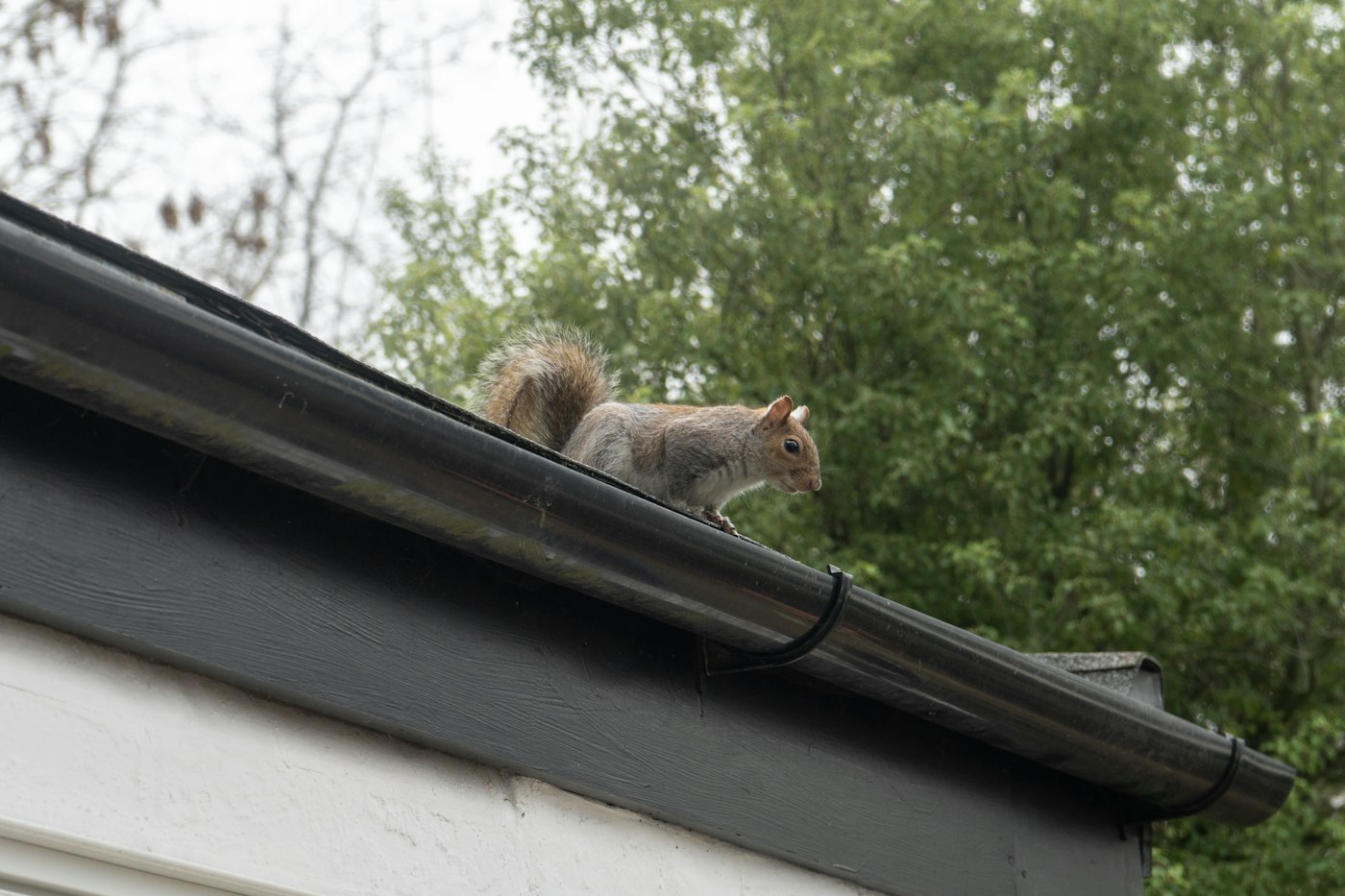
Say what you hear and when
Daylight scrabbling over the bedroom is a different job from heavy movement at two in the morning. A licensed local crew can tell which before anyone gets on a ladder.
3 Young in the attic changes the whole plan
Gray squirrels raise two litters a year in north Georgia, one in late winter and one in midsummer, and a raccoon den in an attic is almost always a female with kits. That single fact decides the sequence of the work. Seal the opening with young behind it and the mother tears a new one, usually within a day and usually worse than the first. If she cannot get back, the litter dies in the insulation and you have a different problem in the same ceiling.
So the order is fixed. Every opening but the main run gets sealed first. The animals come out, by hand where there is a nest to remove or through a one-way door where there is not. Only then does the last opening close, permanently, in galvanized hardware cloth or sheet metal rather than foam or loose steel wool, which both get chewed through or pulled out.
Cleanup is the part homeowners do not expect. Nesting material, droppings and urine-soaked batts are removed, the cavity is treated and insulation is brought back to depth, and in an older Marietta attic with blown fiberglass over a 1970s ceiling that can be a bigger piece of work than the removal itself. Chewed wiring gets checked at the same time. Ask for the sealing and the cleanup as separate lines on the proposal so you can see that both are actually in there.
4 Nearby towns in this hub
The same houses, the smaller tenant: roof rat droppings along a joist, gnawed wiring and what bait stations do and do not do.
Battlefield canopy on three sides, and a permanent squirrel reservoir next door that nobody is ever going to clear.
Median build year 1984 under heavier canopy still, where the limb-to-roof problem is close to universal.
5 Questions
Is wildlife work part of a general pest plan?
Almost never. General plans cover insects and sometimes rodents. Squirrels, raccoons, opossums and bats are a separate scope, often handled by a separate crew, because the work is carpentry and trapping rather than product application.
Can I just put a trap in the attic myself?
You can catch something. You will not find the opening from inside, you will not know whether there is a litter, and Georgia restricts what you may do with several of these species once you have hold of them. A trap with no sealing also leaves the house exactly as open as it was.
Do I really have to replace the insulation?
If it is soiled, yes, and in an older Marietta attic it is usually a bigger piece of work than the removal. Matted, urine-soaked batts stop insulating and the odor keeps drawing animals back to the same spot. Ask for it as its own line in the proposal.
My neighbor had squirrels and they came back the next year. Why?
Because the visit was trapping only. Squirrels in this part of Cobb County keep two or three openings on a house, so closing the one a technician watched them use leaves the others working. Exclusion means every opening, checked from a ladder, and it should carry its own warranty.
Start here
The complete Marietta pest control guide
What a correct job looks like on Piedmont red clay, how crawlspace and slab homes differ, and the questions that separate a real proposal from a guess.
Jaylan Jones — Cobb County Pest Solutions publishes independent guidance for North Georgia homeowners. We are a referral service, not a licensed pest control contractor, and we do not perform the work. How we work.

