
Pest control in Marietta › Guides › Mosquito control in Georgia
The mosquito biting you on your own deck in July almost certainly hatched within a hundred feet of where you are standing, in a container holding less water than a coffee cup. That single fact is why some yards improve dramatically after one season of service and others never do. This page covers the species, the search, what a barrier treatment actually does, and what a misting system is and is not. Start with the complete guide for the wider method.
The weekly habit
Tip and scrub anything that holds water, once a week, all season. Eggs are glued to the sides above the water line and survive drying, so pouring the water out without scrubbing leaves the next generation in place.
1 The Asian tiger mosquito owns this market
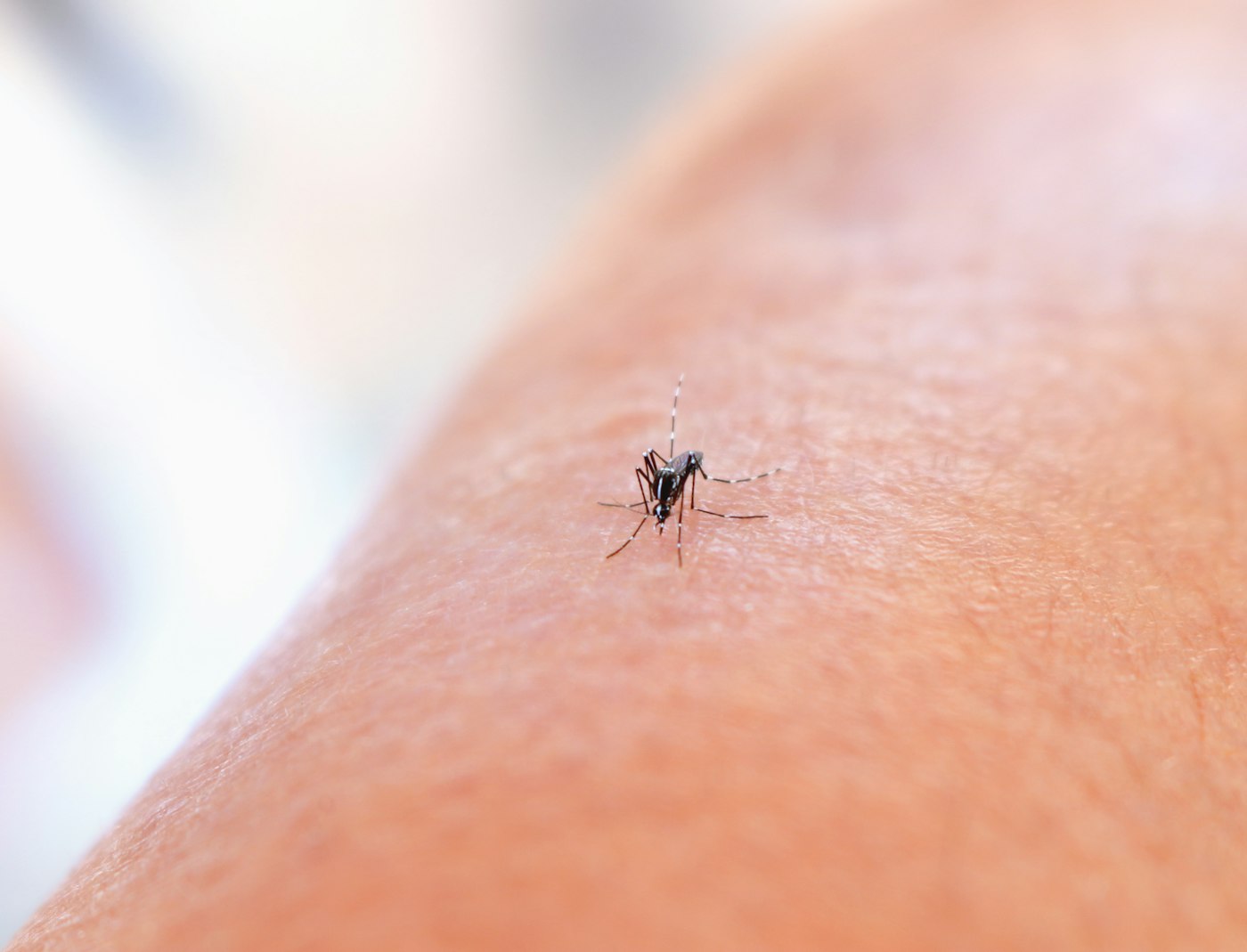
Most people picture mosquitoes as a dusk problem that comes off a pond. In metro Atlanta that picture is wrong. The Asian tiger mosquito is the species doing nearly all of the biting in Cobb County yards, and it behaves differently in three ways that change everything about how you deal with it.
It bites in daylight, with peaks in the morning and late afternoon rather than only at dusk. It does not travel far — a few hundred feet in a lifetime is typical — so the mosquitoes bothering you are yours, or your immediate neighbor’s. And it breeds in containers: a saucer under a potted plant, a corrugated downspout extension, a clogged gutter, a tarp over the firewood, a child’s toy, a wheelbarrow, a bird bath, the folds of a boat cover, a tree hole, an old tire. Creeks and lakes are mostly irrelevant to it, because moving water and large open water are not where it lays.
North Georgia makes all of this worse than it needs to be. The season runs roughly April through October, summer afternoon thunderstorms refill every container on the property in ten minutes, Piedmont red clay drains slowly so low spots stay wet for days, and mature hardwood canopy keeps shaded beds humid and cool, which is exactly the resting habitat adults want. Lots near Sweetwater Creek, Nickajack Creek or Sope Creek, or beside a 1990s subdivision detention pond, have more adjoining habitat than most — but even there the container in your own yard is still the first thing to deal with.
2 Finding the containers
Walk the property the morning after a storm with a flashlight and look into things rather than at them. The usual finds in a Cobb County yard: saucers under potted plants on the deck, the gutter above the garage that has not drained since last autumn, a corrugated downspout extension lying in the grass with water trapped in the ribs, the tarp over the woodpile, a recycling bin with no drain holes, an upturned trash can lid, the dog’s water bowl, a bird bath nobody refreshes, a kiddie pool, a wheelbarrow, an old tire behind the shed, a tree hole in the oak, the saucer under the air conditioner condensate line, and the bottom of a downspout splash block where the soil has sunk.
The method matters as much as the list. Tip the water out, then scrub the inside surface, because eggs are cemented to the walls above the water line and will hatch the next time it rains. Do it weekly through the season, not once in May. Where you cannot remove the water — a rain barrel, an ornamental pond, a drainage structure that always holds — screen it, stock it with fish where appropriate, or use a larvicide product labeled for the purpose and follow the label.
Then fix the drainage faults that keep regenerating water. Clear and pitch the gutters, extend downspouts away from the foundation, fill the low spot in the lawn that holds for three days, repair the irrigation head that floods a bed, and improve the grade where a patio sheds back toward the house. Those repairs serve the rest of the building too, which is the point made throughout the Marietta pest control guide.
Source reduction first, barrier second
A licensed local crew should walk your yard for containers and drainage faults before quoting a season of visits.
3 What a barrier treatment does, and how long it lasts
A barrier treatment is not a cloud sprayed into the air. It is a residual applied to the surfaces where adult mosquitoes rest between blood meals: the undersides of leaves on shrubs and low branches, ivy and ground cover, the shaded side of a fence, under a deck, behind the air conditioner unit, in dense plantings against the house. Adults spend most of their time sitting in that cool humid vegetation, and the treatment works by being there when they land.
Which is why application quality decides the result. A technician who walks the perimeter in six minutes has treated the air. A proper application gets under the foliage, into the shaded interior of the planting, under the deck and around the structure, and it skips flowering plants to protect pollinators. Ask when the application is being made and whether blooming plants are avoided; a company that cannot answer that has not thought about it.
Residuals degrade. Sunlight, heat and rainfall break them down, and a Georgia July supplies all three, so protection fades over a few weeks rather than lasting a season. That is why the work is a series of visits from spring to autumn rather than a single appointment, and why a heavy storm a day after an application is worth a phone call. Treatment also only addresses adults currently in your yard; it does nothing to the larvae in the saucer behind the shed, and it does not stop new adults flying in from next door. That is the structural reason barrier work alone disappoints people, and why the weekly container routine is not optional.

4 Misting systems, traps and the rest
An automatic misting system is permanent tubing and nozzles installed around a yard, releasing product on a timer or by remote. It is a significant installation, it needs refills and servicing, and it has to be maintained properly: a misaligned nozzle, a leak, or a schedule that runs while people are outside is a real problem rather than a nuisance. Timed releases also apply product whether or not mosquitoes are present, which is the opposite of how integrated pest management is supposed to work, and repeated blanket applications raise reasonable questions about non-target insects and resistance.
For a typical suburban lot, a well-executed barrier program plus serious source reduction gets you to a similar place with far less hardware. Misting earns its keep mainly on properties where the pressure is relentless and permanent — heavy adjoining wetland, a lakeside lot, a large shaded property that cannot be walked weekly.
The smaller tools are worth knowing about honestly. In-ground larvicide briquettes in a catch basin or a rain barrel are genuinely useful, because they work on larvae where they live. Fans on a porch work surprisingly well, since these are weak fliers. Repellents applied to skin and clothing work. Bug zappers kill mostly harmless insects and are close to useless for mosquitoes. Ultrasonic repellers do nothing at all. And remember that mosquito work is almost always a seasonal add-on rather than part of a general plan, which is covered under monthly versus quarterly plans. If you want a second opinion on a season of work, start here.
Read next
Lot size, shade, standing water and adjoining habitat are what a company scopes before writing a seasonal proposal.
Mosquito season is usually sold alongside a general plan rather than inside it. Check before you assume.
Source reduction is integrated pest management in its purest form. Here is how that differs from spray-and-go.
5 Questions
When does mosquito season start in Georgia?
Service generally runs April through October in metro Atlanta, and a warm spring pulls the start earlier. Activity tails off as nights cool in late autumn. Starting early matters more than people expect, because the first generations of the year are what build the population you fight in July.
I have no pond and no creek. Why do I still have mosquitoes?
Because the dominant species here does not use ponds or creeks. It lays in small artificial containers: plant saucers, clogged gutters, corrugated downspout extensions, tarps, toys, tires, tree holes. A bottle cap of water is enough. Your breeding site is almost certainly within a hundred feet of your deck.
How long does a barrier treatment last?
A few weeks, not a season. Ultraviolet light, heat and rainfall break the residual down, and a Georgia summer delivers all three. That is why service is a series of visits through the season, and why a heavy storm right after an application is worth mentioning to the company.
Is it safe around pollinators, pets and children?
Applications are made under product labels that set out where and when they may be used, and a careful technician avoids flowering plants and open water, treats resting vegetation rather than blooms, and tells you how long to stay off treated areas. Ask for that guidance in writing, and ask what the company does to protect pollinators.
Do bug zappers or ultrasonic devices help?
Zappers kill large numbers of harmless night-flying insects and very few mosquitoes. Ultrasonic repellers do not work. A box fan on a porch genuinely does help, because these are weak fliers, and skin repellents work. Nothing on that list substitutes for emptying the containers.
Start here
The complete Marietta pest control guide
What a correct job looks like on Piedmont red clay, how crawlspace and slab homes differ, and the questions that separate a real proposal from a guess.
Jaylan Jones — Cobb County Pest Solutions publishes independent guidance for North Georgia homeowners. We are a referral service, not a licensed pest control contractor, and we do not perform the work. How we work.

